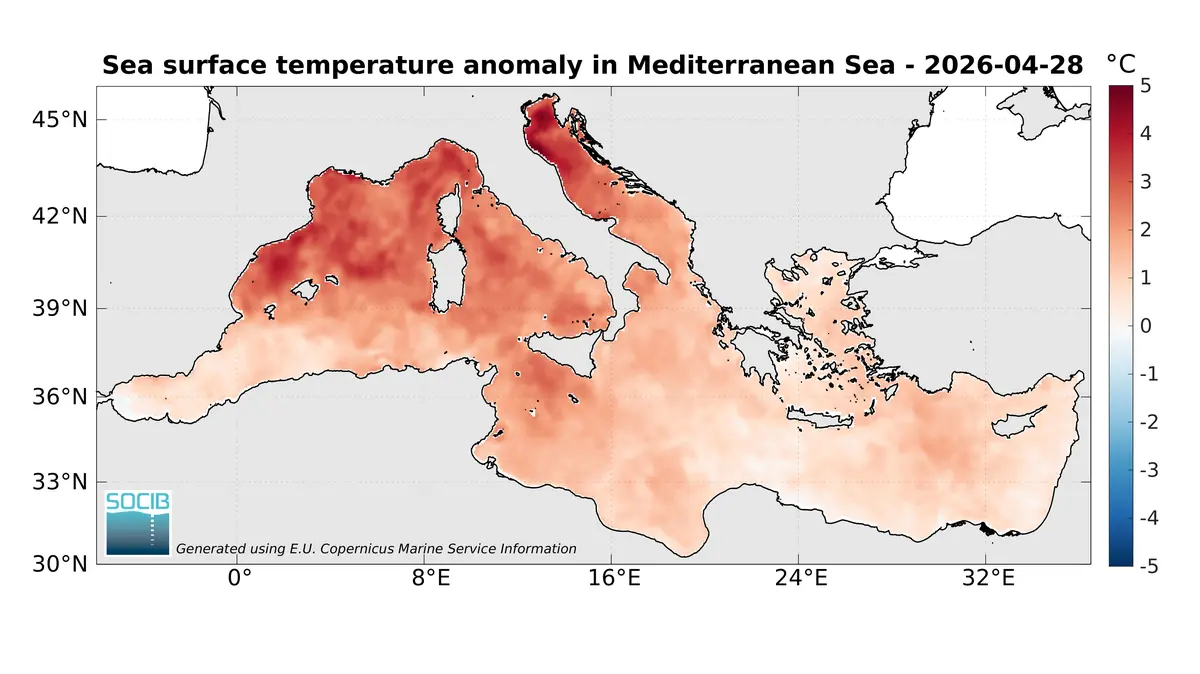
Currently, temperatures in the Mediterranean Sea are on average between 14 and 21 °C depending on the area, but compared to the average since the beginning of the measurement, temperatures are above average everywhere, in some areas by more than 3 °C.
According to the UN, the Mediterranean region is warming 20% faster than the global average. According to their estimates, because of this, the temperature of the Mediterranean Sea could rise by 1.8 to 3.5 °C by 2100, while the temperature should rise the most in the region of Spain and the eastern Mediterranean.
Since the 1980s, the average surface water temperature in the Mediterranean Sea has risen by almost 2 °C, and the rise is still observed. In 2025, the European sea area recorded the highest annual sea surface temperature on record, marking the fourth consecutive year of record warming.
Photo: DMI/C3S/ECMWF
In 2025, 86% of European seas had a strong heat wave
Above-average sea surface temperatures are not only in the Mediterranean. In March 2026, the surface temperature of the global oceans was again at record levels. The average ocean temperature in the area between 60 degrees north latitude and 60 degrees south latitude was the second highest for March on record with a value of 20.97 °C. The oceans were warmer in March only in 2024.
According to estimates, the temperature of the world’s oceans in April should be the second highest in the history of measurements, and according to forecasts, the temperature of the oceans should increase even more this year, because the El Niño phenomenon should occur, which, according to the forecasts, will also be very strong.

Negative influence on nature
The long-term trend of increasing sea temperatures has a negative impact on biological diversity, species and natural habitats. Marine heat waves can coincide with land heat waves, contributing to more extreme temperatures and humidity, including at night, which can also affect people through heat stress and sleep disruption.
Due to the rising temperature of the sea, more moisture also enters the atmosphere, which promotes the formation of thunderstorms with more intense precipitation. This then manifests itself in the form of floods. For example, Spain has been hit by some of the most extreme floods in history in recent years.
The high temperature of the Mediterranean Sea probably also had an effect on the floods in the Czech Republic in 2024.
The combination of high air and ocean temperatures is also not good for glaciers. Due to record-warm oceans and high air temperatures during the winter, sea ice in the Arctic reached its lowest maximum value in the history of measurements.