
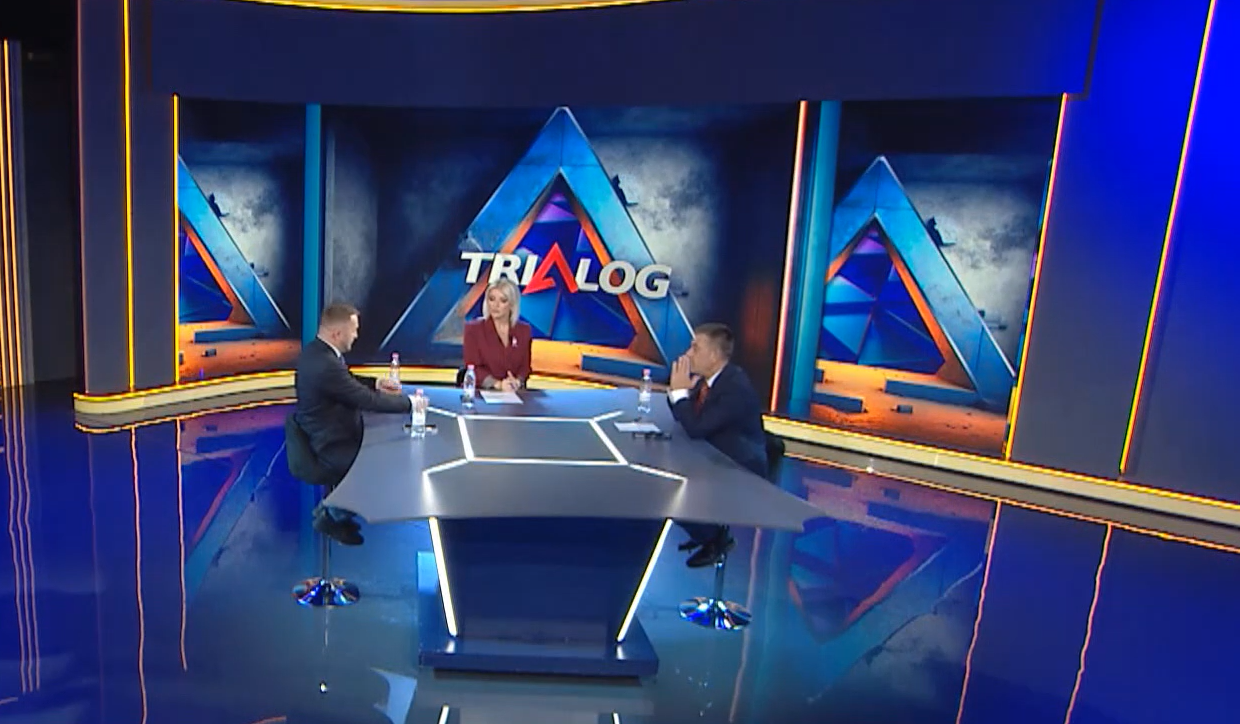
For his part, Lorenc Vangjeli emphasized that the crisis is the element that unites today the three main actors in Pristina: the position, the opposition and the angry citizens in the square.
According to him, Kosovo is catching one of the peaks of the cyclical crises that is expected to lead again to elections, which “will not produce solutions”, because the approach to the problems is wrong.
“All parties are playing a game which at least does not honor us,” declared Vangjeli.
According to him, Albin Kurti is looking for an alibi by promising a law that would limit the powers of the Special Court, knowing that this will not happen, in order to avoid reconsideration of his position.
Vangjeli described the angry citizens in the square as the true victims of the situation.
According to him, people show their anger even through violent means because they see that the political class is immersed in “continuous bloodshed for power and not to build the state”.
He emphasized that Kosovo has entered the second year of a crisis stemming from governance without full institutional legitimacy: citizens vote with high civil awareness, but politics “neither knows how to read, nor can read” their will.
The analyst expressed concern that the scenes of violence and tension in Pristina risk being repeated in Tirana as well, stressing that Albanians, when they have no external enemy, become “merciless enemies” towards each other, putting at risk the national ability to form a state. “What is happening to the Albanian world here and there along the border?” he asked, pointing out that Albania also has its own political crisis.
On the other hand, analyst Flogert Muça reinforced this assessment, noting that the people gathered on the boulevard of Pristina (and potentially Tirana) are the “only sincere core” of the protest, motivated by solidarity with the commanders. According to him, this sincerity is being used and abused by political parties.
“The PDK, since it is the commander’s party, is abusing this more. Albin Kurti, on the other hand… wants to soften the blow to himself as much as possible,” Muça said.
He added that the LDK is also looking for “its share” by positioning itself as the defender of the KLA victims. While in the square people are united around the commanders, the flag and Kosovo, “in the halls of the institutions there are political bargains”.
Muça emphasized that politically there are no elections taking place, but Albin Kurti “is governing in an illegitimate manner”. According to him, the only way for Kurti to continue to govern is not to solve the crisis: “If Albin Kurti solves the crisis… why should he exist anymore? He exists to say that ‘I will solve the crisis’, which he never solves because he needs it as an electoral promise.”
As for the PDK, Muça estimated that their calculations that solidarity with the commanders will automatically be converted into votes are wrong: “Bedriu is not Hashimi, and Kadriu is not Memli… they have done the calculations a little wrong.”
