
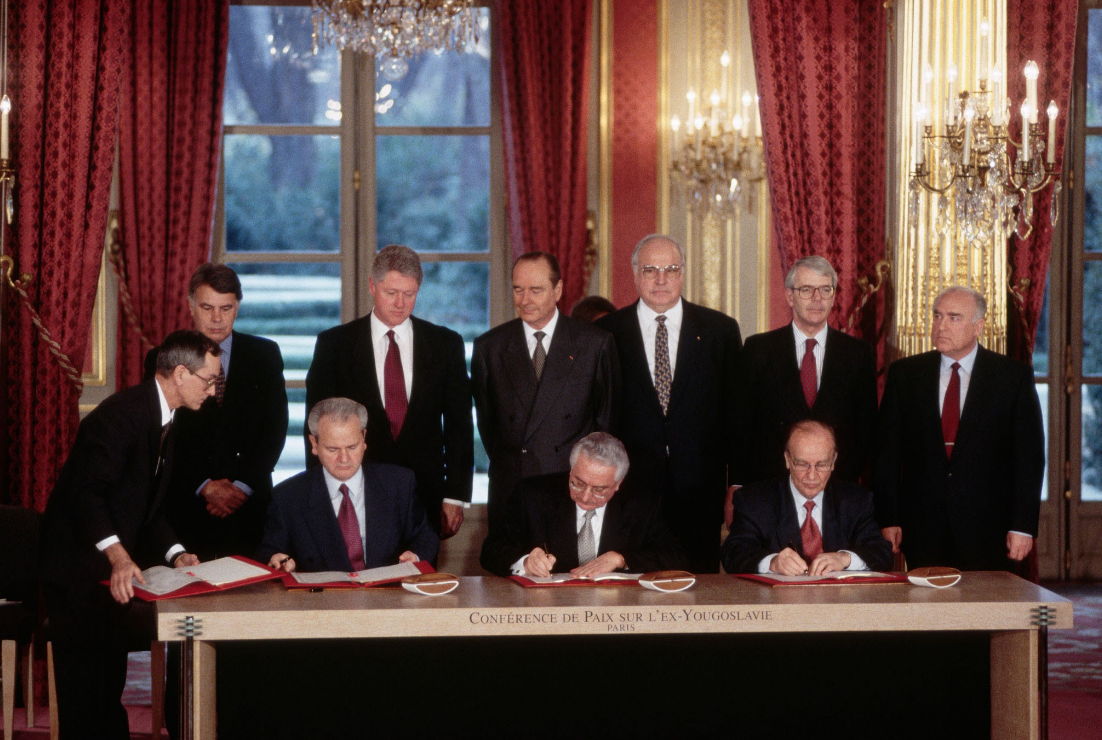
On November 21, 1995, after three weeks of intense and tense negotiations at the “Wright-Patterson” air base in Dayton, Ohio, in the United States of America, the leaders of the Balkans reached a historic agreement to end the bloody three-and-a-half-year war in Bosnia-Herzegovina.
The document, popularly known as The Dayton Agreement (or the General Framework Agreement for Peace in Bosnia-Herzegovina), was signed by the president of Bosnia, Alija Izetbegović, the president of Serbia, Slobodan Milosevic, and the president of Croatia, Franjo Tuxman, under the direct mediation of American diplomacy led by Richard Holbrooke and with the support of European powers. Its formal signature was then held in Paris on December 14, 1995.
The pact ended Europe’s deadliest conflict since World War II, which began in the spring of 1992 after the breakup of Yugoslavia. During three and a half years of ethnic fighting, about 100,000 people lost their lives, while over two million others were forced to leave their homes, accompanied by serious war crimes, ethnic cleansing and the Srebrenica genocide in July 1995.
In addition to the immediate cessation of hostilities and the deployment of NATO peacekeeping forces (IFOR) to enforce peace, the Dayton Agreement also defined the new constitutional and administrative architecture of the Bosnian state. According to this document, Bosnia and Herzegovina remained a single sovereign state within its internationally recognized borders, but divided into two entities with wide autonomy: Federation of Bosnia and Herzegovina (mainly inhabited by Bosniaks and Croats), which owns 51% of the territory, and Republika Srpska (with a Serbian majority), which owns 49% of the territory.
While the Dayton Agreement was praised internationally for its decisive success in stopping the war and restoring stability to the region, it has often been criticized in the following decades for creating a complicated and gridlocked political system along ethnic lines, which has hampered the efficient functioning of Bosnia and Herzegovina’s state institutions.
