
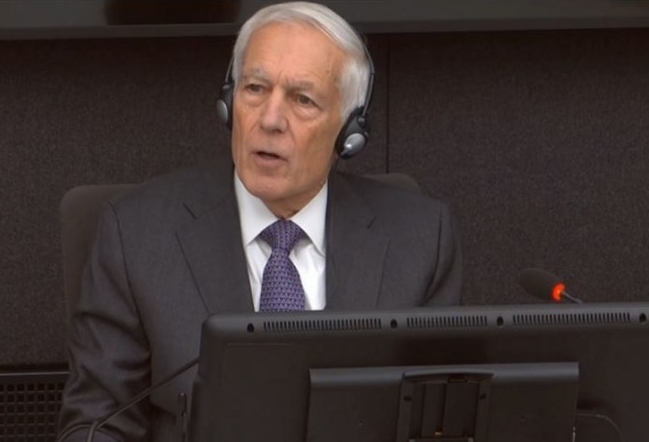
The former Supreme Commander of the Allied Forces for Europe, American General Wesley Clark, has begun his testimony as a defense witness at the Special Court in The Hague, in the trial of Hashim Thaçi and other former leaders of the KLA.
Clark’s testimony focused on the structure of the KLA, the lack of control on the ground after the war, and Thaçi’s role in that period.
Thaçi was a political figure, not a commander
One of the main points of Clark’s testimony was that the KLA leadership, including Thaçi, had no clear control over the sporadic acts of violence following NATO’s entry in 1999.
Clark recalled meetings with Thaci in Rambuje, noting that he was “the youngest, the most obedient, the best dressed,” but “it was not the military commander”.
According to Clark, the KLA did not have a well-coordinated command and control structure. He explained: “It wasn’t like you gave an order and then expected people to follow that order. It was more of a resistance.”
The American general believes that acts of violence after the war, which he attributed to hatred, revenge and criminal gangs, were carried out by “certain individuals”and not by order of the leadership. “I don’t think that Thaçi had control over the people who did such acts.”
Clark concluded the argument of this point by emphasizing that it is “it is unfair to attribute the mistakes of others to Thaç”.
The return to Kosovo and the massacre of Recak
Clark also focused on the critical situation after the war, when NATO’s goal was to establish peace and prevent ethnic cleansing.
He recalled his visit with Javier Solana in Pristina, where citizens received him with deep gratitude for the removal of Serbian oppression, but emphasized that emotions were so strong that sporadic acts of violence were “almost inevitable” in the absence of a trained local police force.
Regarding the Recak Massacre, Clark explained that the international decision not to allow investigations by Slobodan Milosevic’s men stemmed from fears of disinformation and tampering with evidence, a practice Milosevic had used before.
Warning of “Christmas” 1992
The general also testified about “Christmas warning” of 1992, when President George H. Bush asked Milosevic to stop violence against Kosovo Albanians, or the US would retaliate. He emphasized that this was a clear warning to prevent repression in Kosovo, which Milosevic refused to talk about.
Clark will continue his testimony tomorrow, where he is expected to talk about Resolution 1244 and the KLA transformation process.
