
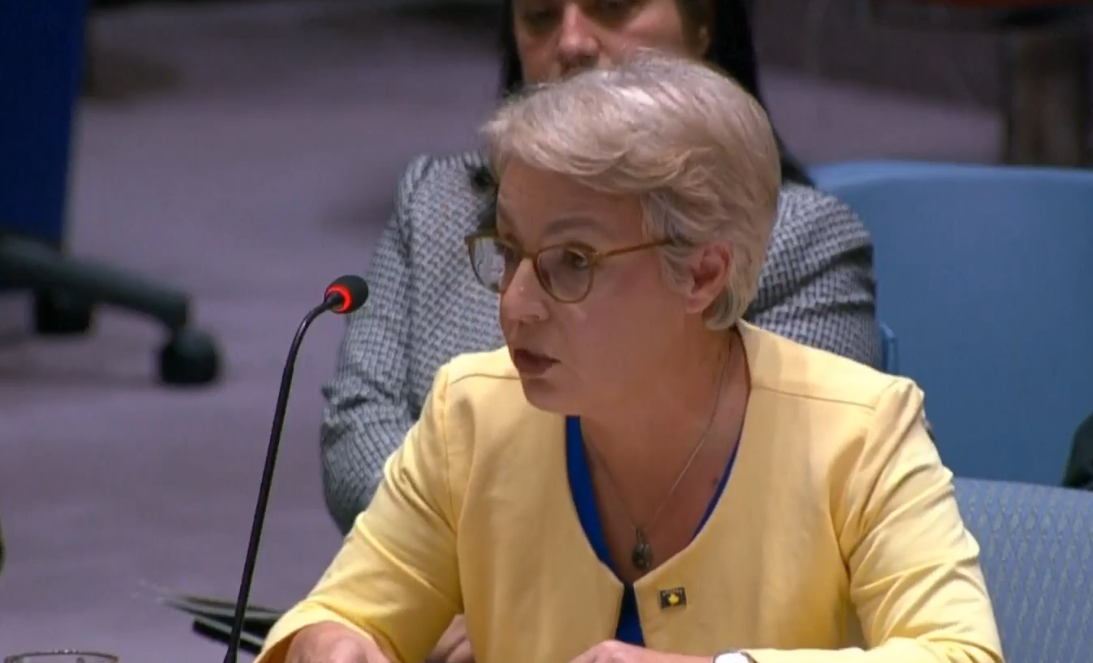
The Acting Minister of Foreign Affairs and Diaspora of Kosovo, Donika Gërvalla, declared today at the session of the UN Security Council that the attack in Banjska in September 2023 and the one in Ibër Lepenc were not isolated incidents, but clear acts of aggression organized by Serbia against the Republic of Kosovo.
During her speech, she accused Belgrade of hegemonic goals and demanded greater pressure from the European Union on Serbia to prevent the situation from escalating.
In her speech, Gërvalla presented a photograph from a football match in Belgrade, where a large graffiti displayed the aggressive message: “When the army returns to Kosovo”.
She emphasized that this message, which does not say “if” but “when”, clearly shows Serbia’s intentions for the destabilization of Kosovo.
“They do not hide their intention, they are open about it. We are in favor of dialogue, but we need a real dialogue, not a deception by Vuçiqi“, said Gërvalla.
Gërvalla accused Serbian President Aleksandar Vucic of directly supporting the attack in Banjska, where armed paramilitary groups from Serbia, led by Milan Radoicic, attempted to take control of northern Kosovo by force.
“The bull can be stumbling, not obeying. Radoicic, Vucic’s right-hand man for Kosovo, is being treated as a guest of honor in Serbia after the attack. The EU must put real pressure on Serbia, otherwise they will continue to escalate, because they have no one to fear,” added Gërvalla, also mentioning a meeting of the Serbian Foreign Minister, Marko Gjuric, with Radoicic after the attack.
Also, Gërvalla reacted harshly to the use of the term “Kosovo and Metohija” by her Serbian counterpart, Marko Gjurić, during his speech at the session.
“Let me make it clear: there is no ‘Kosovo and Metohija’. This is an old chauvinistic expression of Slobodan Milosevic, an expression of Serbia’s hegemonic ambitions towards Kosovo,” said Gërvalla.
She added that Kosovo was protected from the Serbian genocide thanks to the intervention of NATO and the USA and that the country is committed to Euro-Atlantic integration, unlike Serbia, which, according to her, is moving towards Russia.
