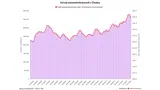
At the same time, these figures do not include only the gross salary. Companies must also take into account contributions for social and health insurance, costs for employee training, recruitment, work clothes or perhaps meal vouchers and a company car. It is the sum of all these items that make up labor costs, which statisticians measure and compare across countries.
The most obvious difference is when compared with Germany. Employers there pay an average of 45 euros per hour of work, which is over 1,100 crowns when converted according to last year’s exchange rate.
“Czech labor costs corresponded to 44 percent of the German level, so a Czech employee still did not cost half as much as a German one, even though his productivity is almost comparable,” stated Creditas Bank chief economist Petr Dufek.
In industry, the difference is even more pronounced. “There, a Czech employee is almost 2.5 times cheaper than a German one. In a situation where other costs are rising sharply, this is still a solid advantage,” explained Dufek. Low labor costs thus remain one of the key arguments why foreign manufacturers continue to invest in the Czech Republic.
However, the rise in labor costs is beginning to influence the strategic considerations of companies. According to a study by the consulting company Strategy&, the transfer of production from Germany to the Czech Republic or Poland no longer brings as much savings as before. The Czech Republic and Poland were the most popular destinations for German companies between 2015 and 2024, but the price of labor here grew three and a half times faster than productivity. Today, only Asia is significantly cheaper.
According to Dufek, the view into the future is also interesting. Over the past 17 years, the Czech wage level has approached the German wage level by approximately 11 percentage points – that is, not even by one point per year.
“If we continue at this pace, Czech wages will reach the level of German wages in 2073,” added Dufek, adding that although this is a simplified calculation, it illustrates well how slow the approach actually is.
Within the entire EU, the cheapest for employers are Bulgaria, where an hour’s work costs just under 300 crowns, and Hungary, with an average of 375 crowns. On the other hand, Luxembourg is the most expensive, over 1,400 crowns per hour – the labor market there is mainly driven by finance, IT and consulting. Slovakia is on a comparable level with the Czech Republic, Poland is slightly lower.
When it comes to purely labor costs without other items, the Czech Republic averaged 368 crowns per hour last year and ranked seventh from the bottom in the EU – just behind Greece and Slovakia, but ahead of Poland, Croatia or Spain. The European average of wages alone exceeded 647 crowns.