Witnesses report that loud cheers erupted in Tehran as news of the death of Supreme Leader Ayatollah Ali Khamenei spread through the city. People ran to the windows, clapping, cheering and playing music. The news was spread, among other things, by Iranian exile media, which can be received in the country via satellite. You could hear honking on the streets.
“The news has not yet been officially confirmed,” the Times of Israel website reported.
“We believe it’s true,” US President Donald Trump said of reports that Khamenei had been killed. He too should have seen a photograph with the body of the dead spiritual leader of Iran.
According to a source in The Times of Israel, Khamenei’s death “will finally allow real peace and bring prosperity to the Middle East.” In addition to Khamenei, other representatives of the Iranian leadership were targeted. “The ballistic missile facilities were destroyed. And the regime is paralyzed,” added the source.
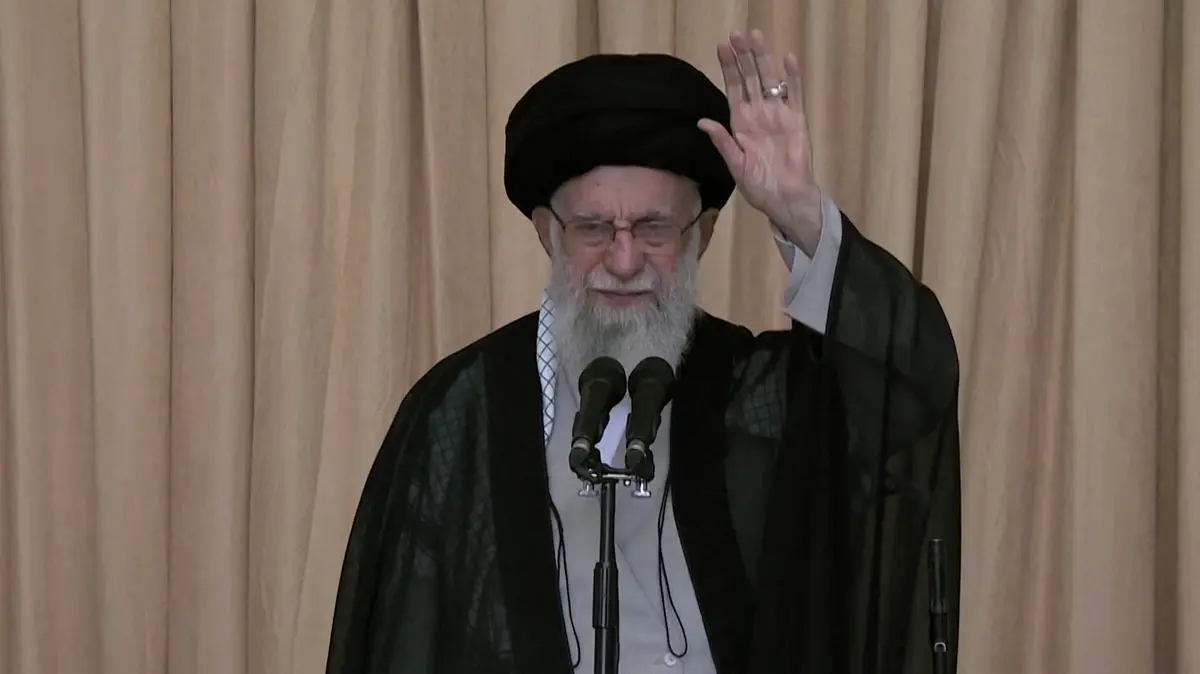
Iran has announced that Khamenei will deliver a speech. For now, he is still being waited for. “The report suggests that if he delivers it, it has been pre-recorded,” The Times of Israel website added.
Satellite images published by the New York Times previously showed the destruction of Khamenei’s palace complex in Tehran after an Israeli airstrike.
“Khamenei is not in Tehran and has been taken to a safe place,” Reuters reported earlier on Saturday. Al-Jazeera’s correspondent indicated earlier that the US and Israel were targeting several places where Khamenei could be staying – with the clear aim of killing him.
We obtained the first known satellite image of Ayatollah Ali Khamenei’s compound in Tehran. There are several destroyed buildings. While the current whereabouts of Iran’s supreme leader are unknown, the compound is generally used as his official residence. 🛰️📸: @Airbus pic.twitter.com/48krjclMBL
— Christiaan Triebert (@trbrtc) February 28, 2026
“I have contacted my sources who indicate that the aim of the US attack is to deprive the Iranian regime of its leadership. They say that the attacks were concentrated in areas where the supreme leader Ayatollah Ali Khamenei could be hiding, so the intention was to try to eliminate the head of the regime and then watch what happens next,” writes the correspondent of the Qatar station.
A paralyzed hand from an earlier assassination
Sayyid Ali Khamenei, who is 86 years old, has been the supreme leader of Iran since 1989, when he replaced Ayatollah Ruhollah Khomeini, the founder of the current theocratic regime.
He was born in 1939 in the city of Mashhad. After studying religion, he became one of Khomeini’s disciples, and was active in the Islamist movement against the regime of Shah Muhammad Reza Pahlavi from the early 1960s. He was imprisoned several times because of this, the Islamic revolution brought him to power.
In the 1980s, he served as president of Iran (1981–1989) before being elected supreme leader after the death of Khomeini. Although he did not have the highest religious title of grand ayatollah at the time, but was only an ayatollah, Khamenei became a leader thanks to the support of conservative clerics and armed forces.
He survived at least two assassination attempts in the 1980s. In the first bomb attack in 1981, he suffered an injury to his right hand, which is still paralyzed today. During last year’s strikes on Iran, Israel also announced that if it had the opportunity to kill Khamenei, it would do so.
Khamenei’s positions are conservative, strongly anti-American and anti-Israel, he supports Shia militias in the region (for example, Hezbollah in Lebanon) and emphasizes “resistance to the West”. But at the same time, it supports technological and military modernization, including the Iranian nuclear program.
In domestic politics, he suppresses the reform movement and often had to intervene against protests (e.g. in 2009, 2019 and 2022).