
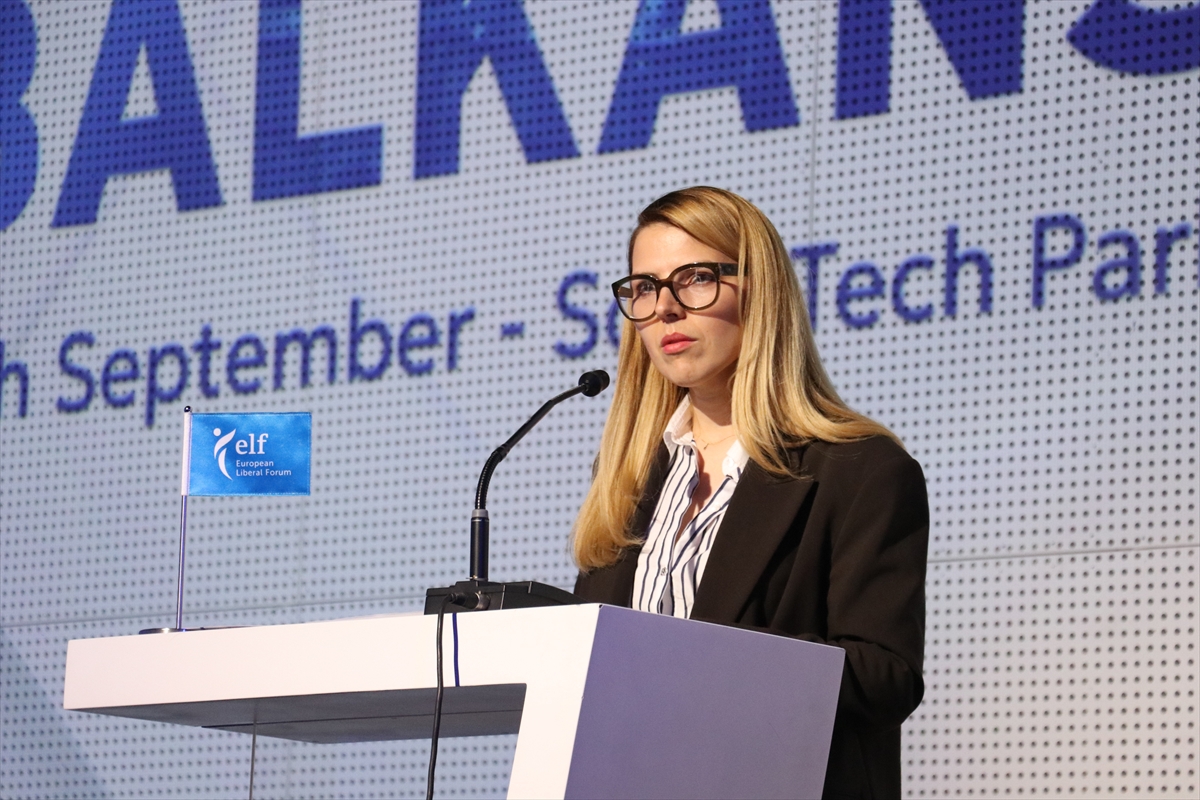
“The European Union (EU) Meets the Balkans” Forum was held in Sofia, the capital of Bulgaria.
At the forum held at the Tech Park Fair Center by the Alliance of Liberals and Democrats for Europe (ALDE), the European Liberal Forum and the Bulgarian Atlantic Club, the integration of the EU and the Balkan countries into the EU, regional cooperation and necessary reforms for the sustainable rapprochement of the countries with the EU were discussed.
In his speech at the opening of the forum, Bulgarian MP İlhan Küçük, from the Renew Europe group in the European Parliament (EP), said that Bulgaria should be an active connection point between the EU and the Balkans.
Küçük stated that the geographical location of the region alone is not enough to turn it into a strategic advantage, and that investments are needed in infrastructure, digitalization and education.
In her speech at the forum, Bulgarian Foreign Minister Velislava Petrova stated that the country’s integration into the EU, the Schengen area and the Eurozone took place at different stages, and that commitment to reforms and the rules, principles and values of the EU should continue after membership.
Stating that the pace of strategic competition and change in the world is increasing, Petrova stated that Europe and the Balkans need strong partnerships and access to technology, raw materials and energy in order to shape their own future.
Deputy Minister of Foreign Affairs and Director for EU Affairs Ambassador Mehmet Kemal Bozay, who represented Türkiye, drew attention to the strategic geographical location of the Balkan countries and said, “The Balkans are seen as a corridor that provides connections.” he said.
Emphasizing that the Balkans should not be seen only as a bridge or transition corridor, Bozay said that the region should be evaluated as a subject with its own geopolitical, geoeconomic and cultural reality.
Pointing out the importance of connectivity in three areas in the Balkans: transportation, energy and data, Bozay emphasized that energy connections will strengthen the capacity of countries such as Bulgaria, Romania and Türkiye.
Bozay stated that Türkiye’s aim in the Balkans is to contribute to the development of the region’s own capacity through regional and bilateral arrangements, and said that the “Balkans Peace Platform” established in this context aims to benefit from these capacities. He noted that the platform is not an alternative to other regional regulations, but a complement.
