
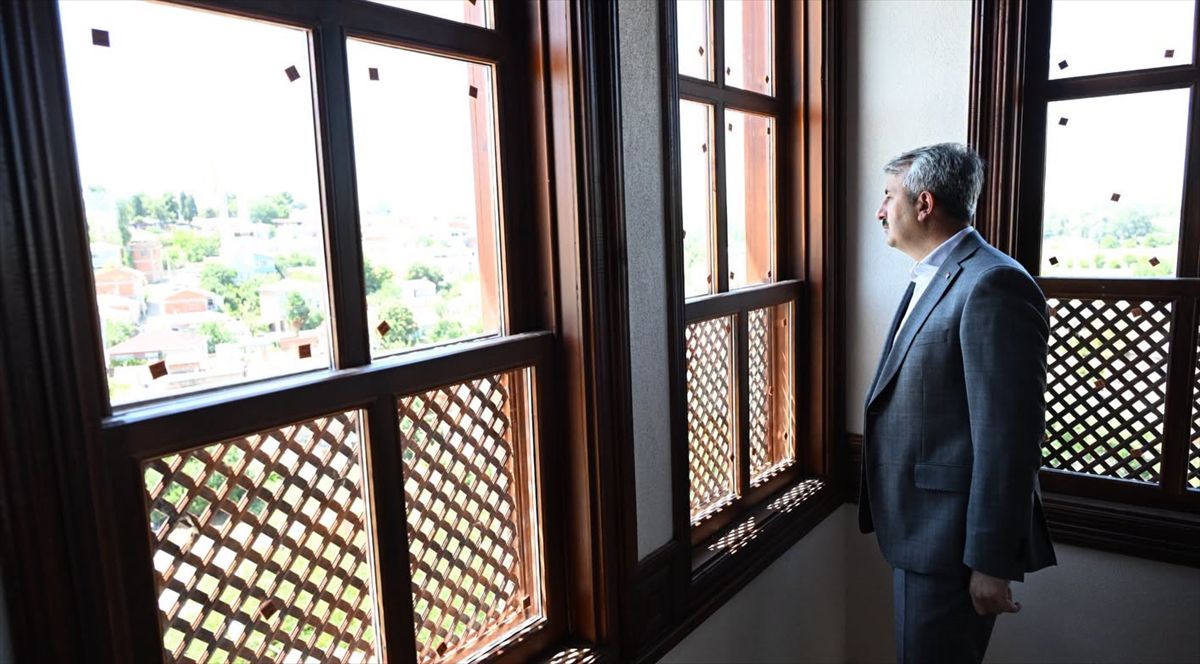
The revival work of the historical Edirne Mevlevi Lodge, which served Edirne and the Balkans for approximately 500 years during the Ottoman period, has come to an end.
Within the scope of the studies initiated in 2024 upon the instructions of Edirne Governor Yunus Sezer, historical sources and old photographs were examined.
Foundation excavation was carried out in order to restore the building to its original state. The survey, restitution and restoration projects prepared in line with the traces were completed.
Then, implementation work began.
Construction works have been completed within the scope of the project carried out by Edirne Governorship Environmental Protection Foundation.
The historical Mevlevi lodge is planned to be put into service after the landscaping and landscaping works are completed.
About Edirne Mevlevi Lodge
According to historical sources, the wooden Mevlevi lodge built by Murat II in the 15th century in the Muradiye Mosque Complex, to the north of the mosque, consisted of lodge buildings, harem room, semahane, dede rooms and library.
From the almshouse, where the food needs of Mevlevi dervishes, students and guests were met, bread was served every day, and rice and zerde were served on Thursdays to the houses in the area reached by the shadow of the mosque’s minaret.
It is stated that the first postmaster of the Edirne Mevlevi Lodge, which is considered as important as the Konya and Afyonkarahisar Mevlevi Lodges, was Mevlana’s grandson, Celalettin Çelebi.
The records contain information that the Mevlevi lodge, which was damaged in the earthquake that occurred in 1752, was repaired in 1753 and again in 1909.
Edirne Mevlevi Lodge was used as a primary school for a while in 1925. The structure was later demolished by General Kazım Dirik, the General Inspector of Thrace.
In the graveyard of the Muradiye Mosque, there are the graves of the sheikhs of the Mevlevi lodge, Celalettin Çelebi, Cemaleddin Çelebi, Mehmet Arif Dede, Osman Dede, Poet Neşati Dede, Seyyid Mahmut Dede, Mehmet Emin Dede, Ali Eşref Dede and Süleyman Dede.
