
The early parliamentary elections of June 7 in Kosovo have not changed the ranking of political forces, but have brought about movement in the electoral support of the parties.
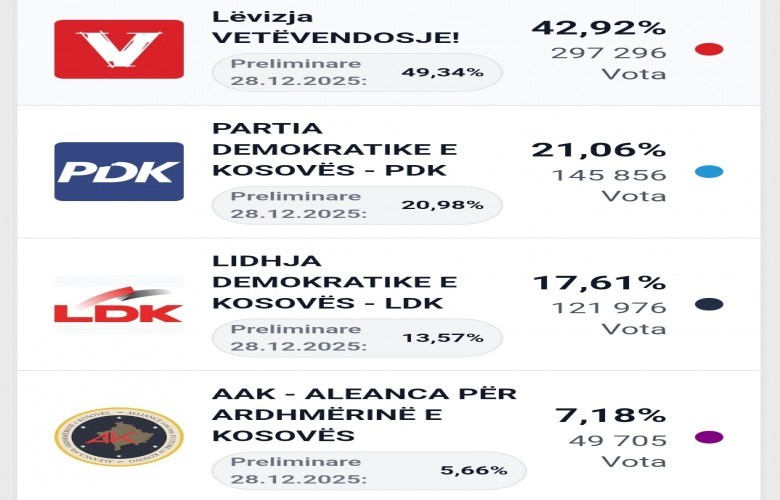
According to the preliminary results after the counting of 99.40 percent of the polling stations, Lévizja Vetëvendosje (LVV) has again emerged as the first political force in the country with 42.92 percent of the votes.
The Democratic Party of Kosovo (PDK) has maintained the second position with 21.06 percent of the votes.
The Democratic League of Kosovo (LDK) secured 17.61 percent of the votes.
Meanwhile, the Alliance for the Future of Kosovo (AAK) won 7.18 percent of the votes.
On the other hand, the Social Democratic Party (PSD) has failed to secure parliamentary representation. According to the preliminary results, she received only 0.27 percent of the votes, or less than 2,000 votes nationwide.
The electoral process was also characterized by a lower participation of citizens. Voter turnout was 36.38 percent, compared to 44.99 percent in the December 2025 elections. This means that about 200,000 fewer voters exercised their right to vote.
The final results are expected to be completed after counting the votes of the diaspora, conditional votes and those of persons with special needs.
According to official data, about 130,000 citizens of Kosovo registered abroad have voted in various ways and their votes may influence the final distribution of mandates in the Assembly.
