
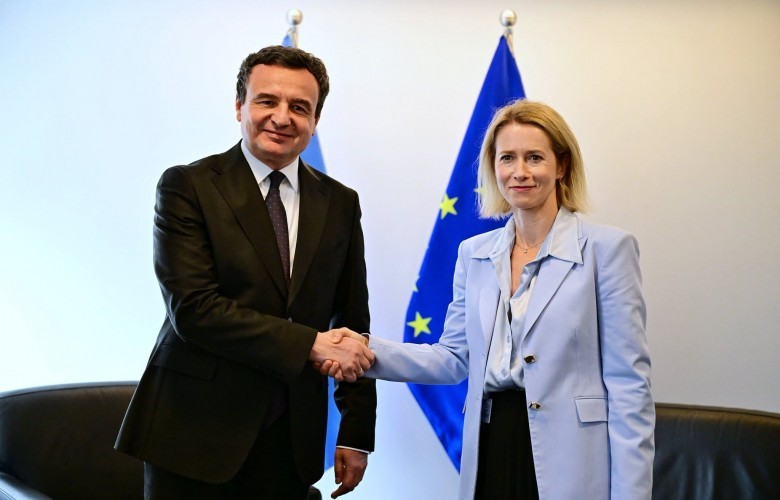
The Prime Minister of Kosovo, Albin Kurti, has raised the issue of the verdict of the first instance of the Specialized Chambers of Kosovo in The Hague during the meeting with the High Representative of the EU for Foreign Policy and Security, Kaja Kallas, at the UN headquarters in New York. Kurti said that during the meeting he expressed his concern for what he described as “severe and unjust punishments” against the former leaders of the Kosovo Liberation Army, stressing that the judicial process has not yet ended. “The Republic of Kosovo will commit to correcting this process and the verdict at the level of Appeal“, stated Kurti.
He has defended the KLA war, arguing that it was a response to repression, murders, massacres and mass deportations of the Albanian population from Serbia.
“The Kosovo Liberation Army was born as a response to repression, murders, massacres, mass deportations and ethnic cleansing from Serbia and its fight for freedom was just and pure”Kurti wrote on Facebook.
According to him, during the war in Kosovo, hundreds of thousands of citizens were expelled from their homes, while thousands more were killed. Kurti also mentioned sexual violence during the war, saying that about 20 thousand women and men are considered its victims. The Prime Minister of Kosovo also said that many of the crimes committed by the Serbian forces have not yet been punished. At the meeting, Kurti also raised the issue of the armed attack in Banjska of Zveçan, recalling that on September 24 it will be three years since the incident where the sergeant of the Kosovo Police, Afrim Bunjaku, was killed.
He asked for the support of the European Union to put pressure on Serbia so that the perpetrators of the attack, including Milan Radoicic, face justice in Kosovo. Kurti accused Serbia of supporting Radoicic and members of the armed group that participated in the Banjska attack. Another issue raised by Kurti was the situation of the Albanians in the Presheva Valley. He said that Albanians in Serbia face discrimination and under-representation in public institutions, also mentioning what he described as “administrative ethnic cleansing” through the removal of residential addresses. Kurti said that Kosovo, unlike Serbia, remains clearly oriented towards European and Euro-Atlantic integration. “We are completely aligned with the foreign and security policy of the European Union”he stated, asking Brussels to give Kosovo the status of a candidate country for EU membership.
