
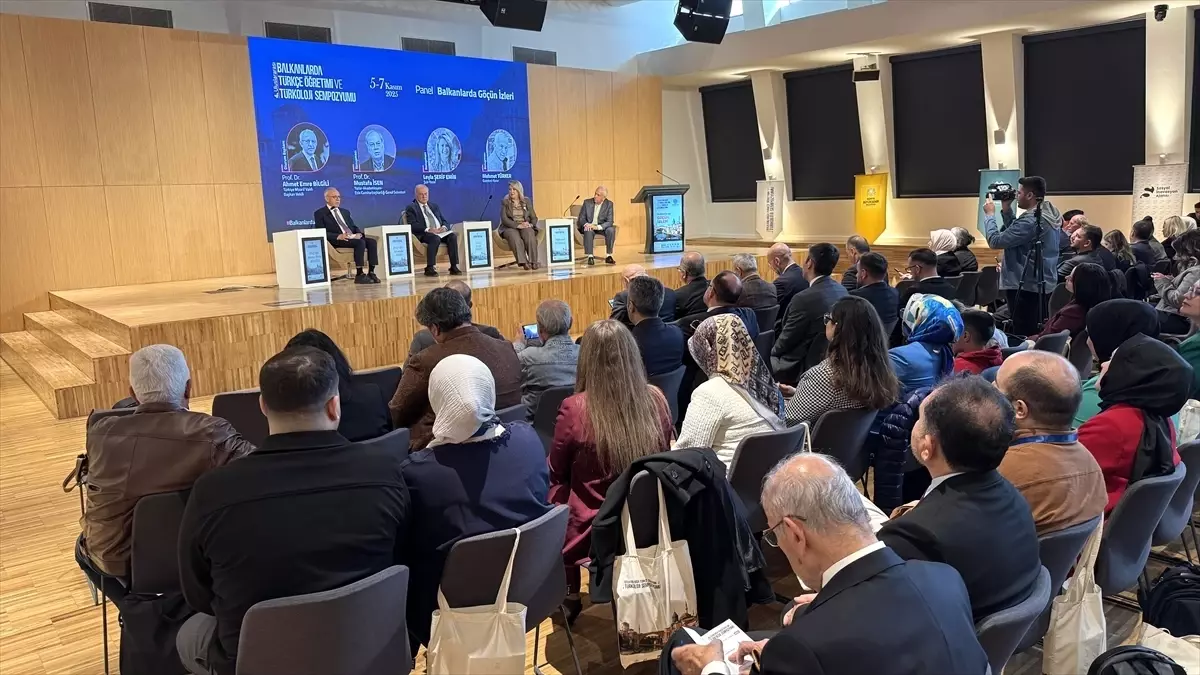
“4th International Symposium on Teaching Turkish and Turcology in the Balkans” started in Konya.
Turkish Maarif Foundation President Mahmut Mustafa Özdil said at the opening of the program held in Stone Building that, as an institution, they set out to share Türkiye’s rich experience in the field of education with the world and to enrich it while doing so.
Stating that they have carried out some studies in this context, Özdil said, “We prepared the Turkish Maarif Encyclopedia. In addition, the Maarif International Education Journal, which we can call semi-academic, has been publishing for a long time. On the other hand, we carry out various academic collaborations.” he said.
Özdil stated that they will organize the Istanbul Education Summit on December 5 and 6, where policy makers, academics, opinion leaders, teachers and students from around the world will come together so that Istanbul can become a center where current issues of education are discussed.
Explaining that there was also a presentation about Africa in this symposium, Özdil said:
“As the Turkish Maarif Foundation, we operate in 64 countries. I can say that there is no geography in which we do not operate. Konya is a very fertile ground for the panel ‘Migration and Traces of Migration in the Balkans’. It is a city that offers very important opportunities in terms of the history of the Balkans and Türkiye’s history in the Balkans. When the relationship between migration and language is discussed, issues that are usually discussed together such as the difficulties experienced by the immigrant, the threats he faces in preserving his language, the change of the language… However, our issue is an issue that shows that this issue should not be discussed only with a negative agenda.”
“The Balkans have become the center of different migration movements”
Rector of New York Tirana University Prof. Dr. Ali Güneş stated that the phenomenon of migration started with the Prophet Adam and continued with the Prophet Muhammad.
Stating that people had to leave their countries for various reasons, Güneş said, “The Balkans have become the center of different migration movements. Because the Balkans served as a bridge between Europe and Asia. When we look at today, we witness a very serious migration in the Balkans. Therefore, when the migration phenomenon is examined, we see that people are faced with an identity dilemma.” he said.
Necmettin Erbakan University Rector Prof. Dr. Cem Zorlu also said that, as a university, they attach great importance to their activities abroad due to the sensitivity coming from education.
Explaining that they give scholarships to successful students through the foundation, Zorlu stated that they hosted guest students from the Balkans in Konya.
Konya Metropolitan Municipality Deputy Mayor Mustafa Uzbaş stated that interest in Turkish and Turkish culture has increased rapidly with the vision of President Recep Tayyip Erdoğan and Türkiye’s increasing political, economic and human power in recent years.
Later, in the session of the panel titled “Traces of Migration in the Balkans”, Deputy Chairman of the Turkish Maarif Foundation Prof. Dr. Ahmet Emre Bilgili, writer and academician Prof. Dr. Mustafa İsen, poet and writer Leyla Şerif Emin and journalist and writer Mehmet Türker spoke.
The symposium, which will last until November 7 with various panels, aims to bring together scientists working on the Balkans in various fields of social sciences, especially Turkish teaching and Turcology activities in the Balkans, to identify the works, studies and interactions in the cultural context, and to evaluate the research and present it to the public.
