
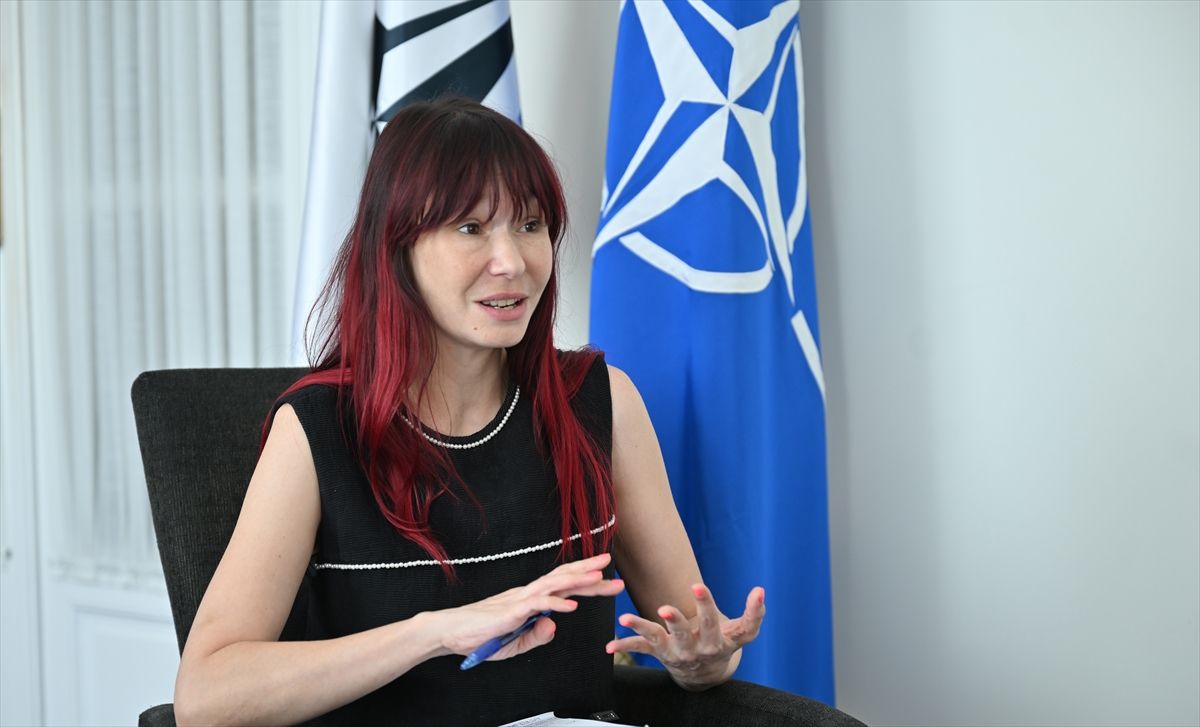
NATO Parliamentary Assembly (PA) Secretary General Benedetta Berti stated that Türkiye is one of the strong allies of the Alliance with the resources it allocates to defense, its military capabilities and its contributions to NATO operations, and said that Turkish parliamentarians also play an extremely active role in the Assembly’s work.
Berti made evaluations to the AA correspondent on the occasion of the NATO Heads of State and Government Summit to be held in Ankara on 7-8 July and the NATO Parliamentary Summit to be held in Istanbul tomorrow and on 29 June.
Stating that NATO is at a very important stage of its evolution, Berti said, “First of all, if we look at the security environment, we are in the most complex and dangerous security environment we have faced since the end of the Cold War, as stated in the last NATO Strategic Concept adopted by the allies in 2022.” he said.
Berti stated that we are faced with permanent hybrid threats ranging from the war in Ukraine, sabotage, cutting of submarine cables and destabilization campaigns, and that instability also prevails in the environment extending from the Middle East to the Eastern neighborhood of the Alliance.
In addition, pointing out that NATO’s stance is stronger than ever since the end of the Cold War, Berti said, “Because we have new defense plans. Allies in Europe and Canada have invested an additional $1 trillion in defense since 2017. Therefore, the data show that we are getting stronger, but it is a fact that the security environment is extremely fragile and variable.” he said.
Türkiye stands out as a strong ally in all three measures
Drawing attention to the importance of Türkiye in this security environment, Berti said, “Turkey has been a NATO ally since 1952, that is, for more than 70 years. Therefore, it is one of the core members of the Alliance. As NATO Secretary General Mark Rutte reminded during his visit to Turkey, Turkey spends more than 2 percent of its GDP on defense and has an incredible defense capacity.” he said.
Referring to inter-parliamentary cooperation, Berti said, “There is a very strong Turkish parliamentary delegation in the Assembly. Turkish MPs are actively participating in our work, and we are even going to Istanbul in a few days. Here, we will organize a summit hosted by the Turkish Grand National Assembly, where we will bring together all the parliamentary speakers of NATO allies. This shows how active a role Türkiye plays in the NATO Parliamentary Assembly (NATO PA).” made his assessment.
The main agenda of the summit to be held in Türkiye, which has a strong defense industry ecosystem, will be “implementation”
Berti said that his main expectation for the Ankara Summit was to move on to “implementation”.
Berti summarized this requirement as follows:
“First of all, in terms of implementing the historic decision taken by the allies last year to increase defense and security-related expenditures to 5 percent of GDP by 2035, the first test will be whether the countries increase their defense budgets every year. The first indicator of success in Ankara will be to show that we continue to invest more in defense. The second test will not only be spending more money but also turning these resources into concrete and complete military capabilities. In other words, it will be important to show that the defense investments made turn into stronger military capabilities. In connection with this, the summit will also discuss how to further strengthen the defense industry infrastructure across the transatlantic alliance.
I think that the summit to be held in Türkiye, which has a strong defense industry ecosystem, will give an important message in this respect. Finally, I think it will show that the support given to Ukraine continues.”
Underlining that every NATO Summit is also a platform where transatlantic unity and solidarity are demonstrated, Berti said, “This issue will also be at the top of the agenda.” he said.
NATO PA assumes an active role in the implementation of the decisions taken at the summits
Berti emphasized that the NATO PA, which has served as a bridge between NATO and the parliaments of the member countries for 71 years, is a very special structure and said, “Because (NATO PA), although it is institutionally separate from NATO, it was created to ensure the establishment of a bond between citizens through parliaments with the decisions taken in NATO. In order for the transatlantic alliance to remain strong, there must be strong relations not only between governments but also at the political level and among the people. NATO PA undertakes exactly this task.” he said.
Stating that the members of the Assembly, which has 281 members from 32 allied countries, are parliamentarians representing the entire political spectrum of their own countries, Berti said, “They come together to create consensus, strengthen transatlantic ties and discuss security and defense issues. Today, the importance of this has increased even more because we are going through a historical period for NATO.” he said.
Berti emphasized that decisions are taken at summits but implemented in parliaments and continued as follows:
“Parliaments approve the budgets that will ensure the continuation of defense expenditures. Parliaments change the procurement legislation in order to acquire defense capabilities more quickly. Parliaments pass laws that will support the defense industry. Therefore, parliaments have a central role in turning the decisions taken at the summits into reality. NATO PA also plays a very important role in this process.”
Stating that he had the opportunity to listen to the views of parliamentarians on the Alliance’s agenda thanks to his duty, Berti said, “I see that all MPs in NATO PA are aware of the importance of investing more in defense. In particular, allies in Europe think that Canada, the UK, Turkey and Norway should develop more capabilities to create a more balanced transatlantic relationship. Thus, they believe that they can assume a greater leadership in the conventional deterrence and defense of Europe over time.” shared his opinion.
Pointing out that parliamentarians are aware of the need for open, honest and sincere dialogue with citizens, Berti said, “We need to explain to the public why more defense investments are needed. We must explain the threats and challenges we face. Sometimes we have to talk about difficult choices because while allocating more resources to defense, sacrifices may need to be made in other areas. This is not an easy discussion, but the message I want to give is this: Without security and defense, there is no prosperity, no economic growth, no peace. Therefore, we have no other option.” he said.
Berti stated that defense investments can also be seen as a tool that supports the economy and said, “We discuss all these issues in the Assembly, but ultimately the issue is to establish open, transparent and constructive communication with citizens.” he said.
Turkish Grand National Assembly will host the NATO Parliamentary Summit
Berti also touched upon the NATO Parliamentary Summit, which will start tomorrow and last for two days under the leadership of the Speaker of the Turkish Grand National Assembly, Numan Kurtulmuş, in Istanbul and said:
“NATO PA has been organizing a separate summit of heads of parliaments shortly before the NATO Summit for the last few years. In this meeting, we bring together the heads of parliaments of NATO countries and evaluate what the decisions taken by governments at the NATO Summit mean for parliaments. This time, we will focus specifically on what role parliaments will play in the implementation of the 5 percent defense investment target. How will parliaments support defense budgets? How will they enact the necessary laws? How will they create the appropriate environment to encourage the growth of the defense industry? In other words, the main purpose is to transfer the decisions taken at the summit to the parliaments.” “and to evaluate how we can contribute to the implementation of these decisions together with the heads of parliament, the highest-level legislative representatives in their countries.”
