
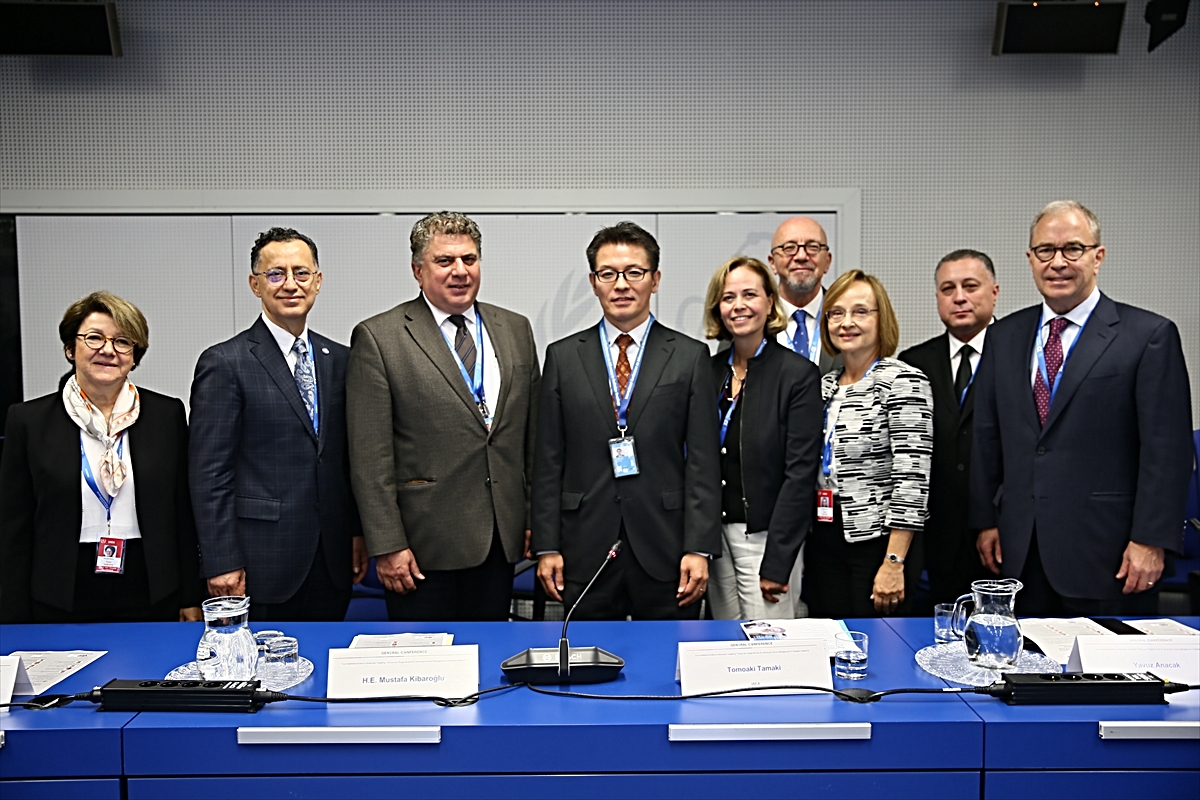
At the side event organized within the scope of the 70th General Conference of the International Atomic Energy Agency (IAEA), Türkiye’s role as a regional center in the field of advanced cancer treatments was discussed.
As part of the ongoing conference in Vienna, the capital of Austria, a side event titled “From Bullets on the Battlefield to Molecular Targeting: Türkiye as the Regional Center of Advanced Cancer Management in Radiation Medicine” was held.
The event, hosted by the Ege University Faculty of Medicine, designated as the first “Support Center” within the scope of the IAEA’s “Rays of Hope” initiative, and the Turkish Energy, Nuclear and Mining Research Agency (TENMAK), was attended by Türkiye’s Permanent Representative to the UN Vienna Office, Ambassador Mustafa Kibaroğlu, Ege University Vice Rector Tahir Yağdı, US-based St. Jude Children’s Research Hospital, Department of Radiation Oncology, Dr. Many experts attended, as well as Thomas Merchant and Tomoaki Tamaki, Head of the IAEA Applied Radiobiology and Radiotherapy Unit.
In his opening speech of the event, Ambassador Kibaroğlu stated that radiation is one of the indispensable foundations of modern health services and drew attention to the importance of the role it plays in the diagnosis of diseases, especially cancer.
Expressing that Türkiye has a deep-rooted history in this field, Kibaroğlu said that Türkiye’s medical community pioneered practices in battlefields in the 19th century and steadily improved its institutional capacity throughout the 20th century.
Stating that in recent decades, this foundation has turned into a modern national infrastructure with the support of a highly qualified workforce, Kibaroğlu said, “Today, Turkey, as a dynamic regional center, offers advanced cancer treatment not only to our own citizens but also to patients in neighboring regions.” he said.
Türkiye’s role in the field of nuclear medicine and radiation oncology
In the presentations made at the event, it was stated that Türkiye has a deep-rooted history in the field of nuclear medicine and radiation oncology and offers a wide diagnostic and treatment infrastructure that can be easily accessed by patients in need.
It was explained that Türkiye provides health services, education and technical support not only to its own citizens but also to a wide geography stretching from the Balkans to Central Asia, from the Caucasus to the Middle East and North Africa. It was noted that these services are provided in Türkiye and in health facilities operated by Turkish organizations in the region.
It was stated in the presentations that Türkiye has 75 years of experience in the field of nuclear medicine, and that the infrastructure and services in the country are at a level comparable to developed countries. It was stated that there is a need for a strong strategy that will increase scientific research, international cooperation and Türkiye’s visibility in this field.
At the event, where the development of nuclear medicine and radiation oncology in Türkiye, from x-ray applications used on battlefields in the 19th century to modern oncology, was emphasized, the country’s technological infrastructure and trained human resources in the field of cancer diagnosis and treatment were emphasized.
The program ended with the closing speech of Tomoaki Tamaki, Head of IAEA Applied Radiobiology and Radiotherapy Unit.
