
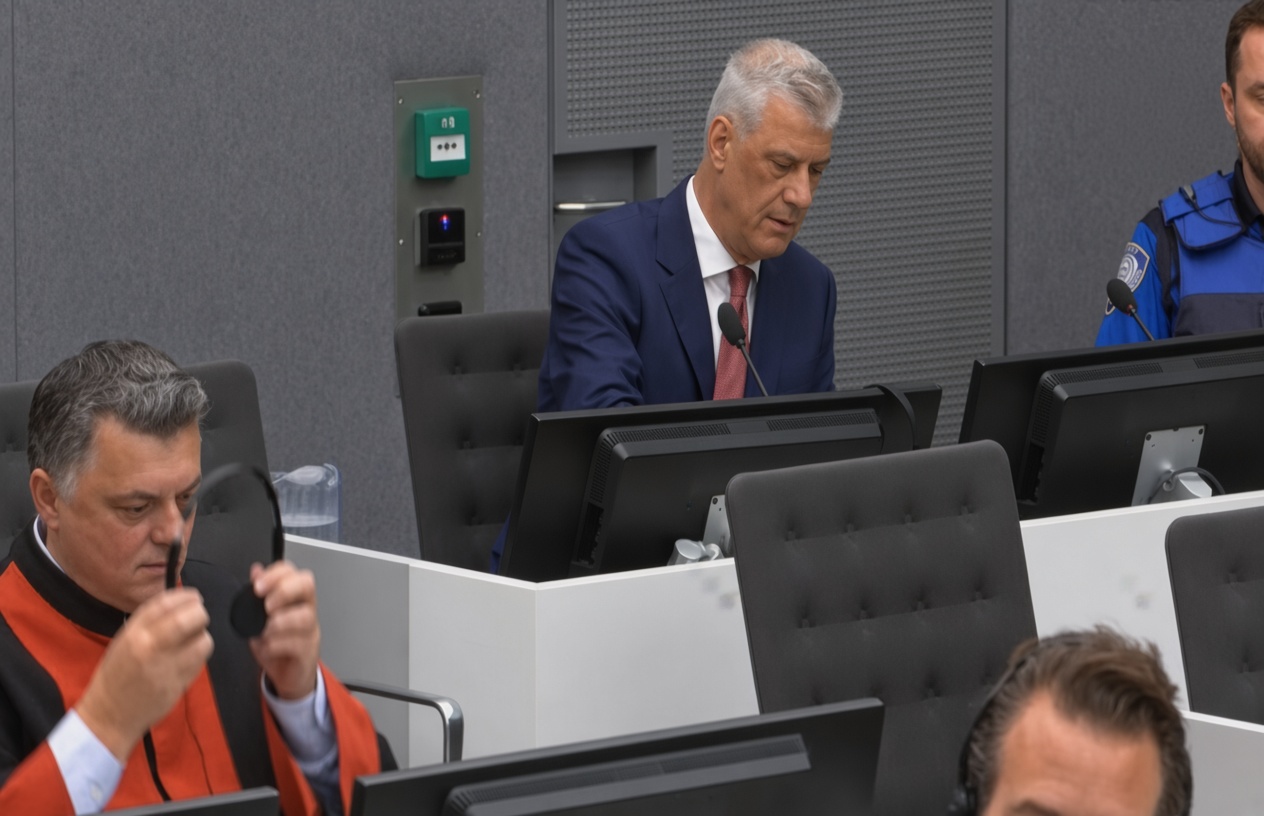
In the Specialized Chambers of Kosovo in The Hague, the final statements in the judicial process against Hashim Thaçi, Bashkim Smakaj, Fadil Fazliu, Hajredin Kuçi and Isni Kilaj, who are accused of criminal offenses against the administration of justice, have begun.
During the hearing, Chief Prosecutor Kimberly West and Prosecutor Joshua Hafetz presented the arguments of the Special Prosecutor’s Office, claiming that the accumulated evidence proves organized efforts to obstruct justice.
Chief Prosecutor Kimberly West stated that the audio evidence and collected documents show that Hashim Thaçi, even though he was in custody, instructed the co-accused to influence the main witnesses of the process.
According to her, the purpose of this network was for witnesses to change or adjust their confessions. West singled out Thaçi’s alleged instruction to the witnesses with the phrase “do not cause any harm there”, where according to the Prosecution, “harm” referred to the implicating evidence, while “there” meant the Court itself.
West further alleged that Thaçi had given instructions to the co-accused on how witnesses should justify changes in their previous statements – using excuses such as translation errors, fatigue or treating information as mere hearsay.
For his part, the prosecutor Joshua Hafetz announced that in the context of the case, about 28 hours of audio recordings were received, made during nine visits in a four-month period inside the detention center.
Hafetz described how Thaçi would speak in a normal voice about everyday topics and then lower his voice to give concrete instructions on what to convey to witnesses from visitors, with the aim of softening the charges in the main case.
The prosecutor also criticized the defense strategy, accusing it of avoiding the facts that emerge from the recordings and of relying on a witness who, according to him, had only heard unspecified parts of the transcripts and could not answer basic methodological questions.
The judicial process is continuing with the presentation of the arguments of the parties in the Specialized Chambers.
