
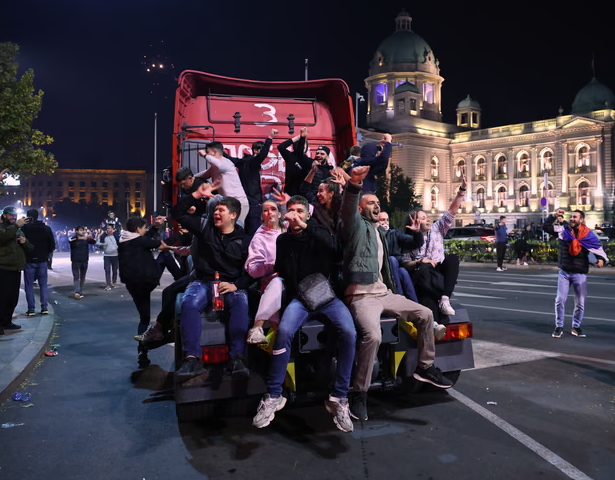
The student movement in Serbia, which scored a historic election victory, is preparing to start talks on forming a new government, with the aim of overturning 14 years of increasingly authoritarian and nationalist rule. However, the victory of the Student List also brings great challenges, as the movement has no experience in governance and does not yet have a defined leader.
Her supporters took to the country’s streets on Monday to celebrate the loss of Aleksandar Vucic, the former president who dominated Serbian politics for more than a decade. Vucic conceded defeat on Sunday night, ending a long era of power for his party.
The result comes after two years of anti-government protests, sparked by the November 2024 collapse of the railway station canopy in Novi Sad, which killed 16 people. The tragedy fueled public outrage and demands for accountability, transparency and the fight against corruption.
According to projections by the Center for Free Elections and Democracy in Belgrade, after all ballot samples were counted, the Student List secured 53% of the vote, which translates into 141 mandates in the 250-seat parliament. Vucic’s Serbian Progressive Party (SNS) took 39%, securing 103 seats. The remaining seats were divided between the lists of national minority parties.
Despite the convincing victory, it remains unclear how the new government will function. The movement, built on collective decision-making and without a well-defined hierarchy, included academics, actors, farmers and students in its ranks. Consequently, it is not yet known who will be nominated for prime minister and who will be the members of the cabinet.
Among the movement’s well-known figures are cardiologist Ilija Srdanovic, who headed the list of candidates, former central bank governor Dejan Shoshkic and University of Belgrade chemistry professor Radomir Saicic.
The challenges facing the Student List are similar to those of Peter Magyar’s Tisza party, which ended Viktor Orban’s 16-year rule in Hungary this spring. In both cases, the political change is faced with public institutions where a part of the administration is considered connected to the previous government, which can make their reform difficult.
“Every person in the student movement and every candidate on the list fully and clearly understands the weight of the responsibility before us,” declared Ana Mirkovic, education lecturer, psychologist and candidate of the Student List.
“We do not see the result of the elections as taking power and privileges, but as assuming a historic debt to our people and our children,” she added in an interview with The Guardian.
Mirkovic emphasized that the first priority of the new government will be the “social and psychological detoxification” of the country.
During the 14 years of Vucic’s rule, the Serbian political system has been described by critics as a model of autocracy, with the ruling party expanding its influence over the media, judiciary and other state institutions. The elections have been accompanied by accusations of irregularities in voter registration, media favoritism and vote buying.
The students’ platform focuses on the fight against corruption and the restoration of the rule of law. Among the main proposals is the creation of an independent police unit that will be subordinate to the prosecution and not to the Ministry of the Interior, as well as the removal from duty of the officers associated with organized crime.
The move also aims to stop political appointments of party loyalists to state-owned enterprises and strengthen public control over finances. To this end, it proposes the creation of independent bodies that will oversee large infrastructure contracts, with the aim of preventing the misuse of public funds.
According to Mirković, the new government will aim to dismantle a “system of intimidation” that feeds fear and polarization in society. She promised the immediate opening of the media, the cessation of pressure on public sector employees and the prohibition of what she described as “institutional violence”.
The goal, according to her, is to “rebuild society from the ground up”, through full publication of contracts and financial flows, depoliticization and strengthening of the judiciary, as well as reforming education and health. Mirkovic emphasized that the capture of the state by political interests should not be repeated.
Foreign policy, still an open issue
During the campaign, Student List sidelined controversial foreign policy issues, including relations with the European Union and Russia, focusing on Serbia’s internal problems.
The Kremlin said on Monday that it hoped the new leaders would understand that cooperation with Russia is in Serbia’s interest.
Analyst Dušan Vučičevič said that the movement had insisted that the country deal with internal political problems first, aiming, according to him, “to literally dismantle every institution, from the national to the local level.”
He described the victory as a profound political change that could inspire other student movements in Europe, which in recent weeks have protested for improved education standards and prospects for young people.
However, Vucicevic warned that the Serbian model cannot be easily copied in other countries. “This experiment in grassroots democracy ultimately managed to secure more than 50% of the vote,” he told Agence France-Presse, adding that it remains unclear whether a similar model could work elsewhere.
Even Nikola Burazer, program director at the Center for Contemporary Politics in Belgrade, emphasized that the movement’s decision-making process should be accelerated. According to him, the selection of candidates had lasted for months.
“After people finish celebrating and think about what happened yesterday, we will focus more on what comes next and what the government will look like. Twenty-four hours ago, all this seemed like a fantasy,” said Burazer.
Vucic, who maintained close ties to Russia while in power, attributed his party’s defeat to “the direct support of various European countries and the American deep state, which is also against President Trump.”
International reactions after the students’ victory
The victory of the Student List was hailed by several international leaders. Ukrainian President Volodymyr Zelenskyy described the result as a new chapter in the history of Serbia and its people.
“We wish Serbia success, real development and warm relations with the European community. We in Ukraine thank Serbia for respecting our people, state and independence. And we always celebrate our joint achievements”, stated Zelenskyy.
The German Chancellor, Friedrich Merz, said that Berlin will actively support Serbia’s European path. According to him, the students have managed to gain the support of the citizens with their demands for the rule of law, the fight against corruption and respect for basic freedoms.
According to the Constitution of Serbia, the new parliament must convene within 30 days of the official announcement of the final election results. After its meeting, the deadline for the formation of the new government is 90 days.
Meanwhile, Serbia must hold new presidential elections before December 27, after Vucic stepped down as president to run for prime minister.
The victory of the students marks the end of a political era in Serbia, but the real challenge begins now: turning the promises of the fight against corruption and reforming institutions into concrete changes.
