
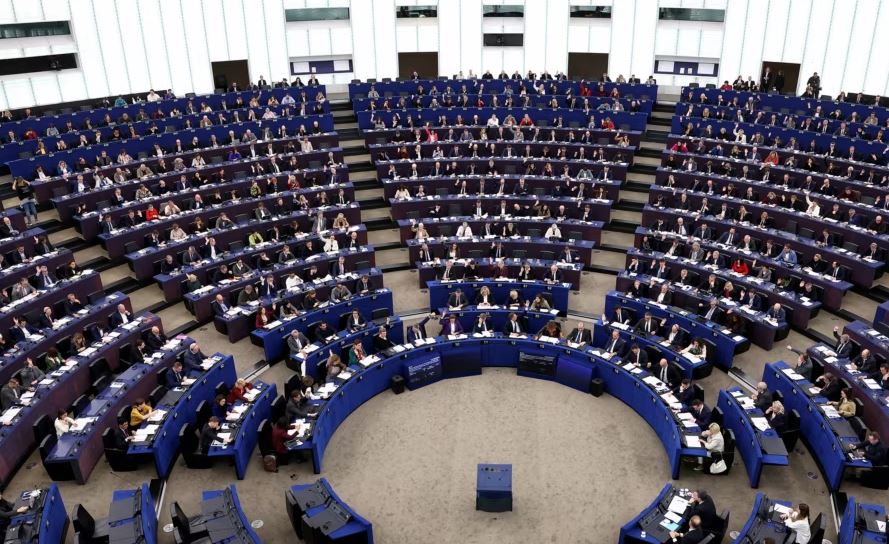
The European Parliament has adopted a resolution for Kosovo, which states that reforms and progress in the Kosovo-Serbia dialogue remain key to the country’s European path.
The resolution was approved with 412 votes in favor, 174 against and 58 abstentions.
“The continuation of the reforms and the progress in the dialogue mediated by the European Union remain key to the European path”, wrote in X the rapporteur for Kosovo in the EP, Riho Terras, after the adoption of the resolution.
The resolution welcomes Kosovo’s continued commitment to the integration process. In this context, it is said that the dialogue for the normalization of Kosovo-Serbia relations, which is mediated by Brussels, remains an integral part of Kosovo’s European perspective.
Kosovo and Serbia have not held high-level dialogue since September 2023, a few days before the armed attack in Banjska.
Acting Deputy Prime Minister, Glauk Konjufca, stated at the beginning of May that he does not expect any development in the dialogue this year.
“Let’s see in 2027 how things will develop, but due to the developments, I don’t expect anything, nor any European initiative very focused on these remaining months of the year,” he said on May 11.
He said that the biggest problem in the dialogue lies in the “attack on good faith” that was done to the process “on the part of Serbia”.
Konjufca said that the attack in Banjska in 2023 and the one in the Ibër-Lepenci canal in 2024 damaged the trust in the process of normalization of relations, which started in 2011 and which is mediated by the EU.
In the approved resolution of the EP, the position that 2025 was a lost year for the country was repeated, noting that even the months of 2026 are at risk of loss due to the political crisis.
The resolution states that due to the political situation, Kosovo may lose financial resources from the Growth Plan, as there is a fear that Kosovo will not be able to meet the necessary criteria.
The EU package for the Western Balkans – for the period 2024-2027 – is worth 6 billion euros. Of this amount, Kosovo is entitled to about 882 million euros – 253 million in grants and 629 million in the form of loans – which means that the country receives the most funds in the region per capita.
The end of June this year is the deadline when each state of the region enters the so-called moment of permanent loss, if it does not fulfill the reforms agreed in advance.
Earlier, sources told Radio Free Europe that if all reforms are not undertaken, Kosovo could lose 68.8 million euros.
During the political crisis last year in Kosovo – when the country held two parliamentary elections due to the impossibility of forming institutions – funds from the Growth Plan, but also funds from other international mechanisms, were questioned.
Kosovo held early parliamentary elections on June 7, because the previous legislature failed to elect a new president. The winner of the elections is the Vetëvendosje Movement of acting Prime Minister Albin Kurti, a party which is expected to have 53 seats in the 120-seat Parliament.
Previously, at the beginning of June, this resolution – which was in the form of a report – was debated in the Committee for Foreign Policy of the EP (AFET).
At the June 3 meeting, the rapporteur for Kosovo in the EP, Riho Terras, stated that the last 18 months have been difficult for Kosovo.
“The political stalemate has a significant impact on the future of the country. It is important that Kosovo stays on the European path and moves forward with integration,” he declared.
Terras also said that he hopes that after the June 7 elections, Kosovo will get out of the political impasse.
The resolution also expresses strong support for Kosovo’s goals for integration into the European Union. Also, regret is expressed for the political deadlock and, as said, the polarization that are accompanying the country, as well as for the numerous election processes of recent years.
The resolution also provides support for Kosovo’s application for the status of a candidate country and calls on the member states to, without unnecessary delay, mandate the European Commission to compile the questionnaire.
Kosovo has applied for EU membership at the end of December 2022. However, Pristina’s application has not yet been reviewed by the EU.
The Council of the European Union, according to the resolution, is invited to act quickly and grant Kosovo the candidate status, once the relevant criteria have been met.
Also, the five non-recognizing EU states – Romania, Greece, Slovakia, Spain and Cyprus – are called to recognize Kosovo’s independence, in order to enable equal advancement of Kosovo with other candidate states.
In this regard, the opinion of the International Court of Justice (ICJ) in 2010 is recalled, according to which the declaration of independence of Kosovo does not constitute a violation of international law.
The resolution also welcomes the decision, as it says, “albeit delayed”, for the removal of the punitive measures that the EU had imposed on Kosovo and it is emphasized that they were in clear opposition to Kosovo’s demonstrated commitment to European values and alignment with the policies of the European bloc.
It states that the measures were unjustified and that they had a negative impact on the society of Kosovo.
The resolution questions the lack of transparency and predictability, the level of public information, as well as the extended duration of the measures, despite the fact that Kosovo had fulfilled the requirements for their removal.
Kosovo and Serbia, through the resolution, are called to cooperate and take all necessary measures to bring the perpetrators of the 2023 attack in Banjska to justice as soon as possible.
On September 24, 2023, a group of armed Serbs attacked the Kosovo Police in Banjska, killing a sergeant. During the exchange of fire, three Serbian attackers were also killed.
Kosovo considers this attack terrorist and blames Belgrade. But Serbia denies involvement.
For the attack in Banjska, the authorities in Kosovo have convicted three accused, while dozens more are on the run. Millan Radoicic, the former vice-president of Lista Serbe – the main Serbian party in Kosovo that enjoys the support of Belgrade – has claimed responsibility for organizing the attack, as Kosovo has repeatedly demanded that Serbia extradite him.
The EP resolution expresses regret for the fact that Serbia has not yet prosecuted those responsible for this attack, especially Radoicic./ REL
