
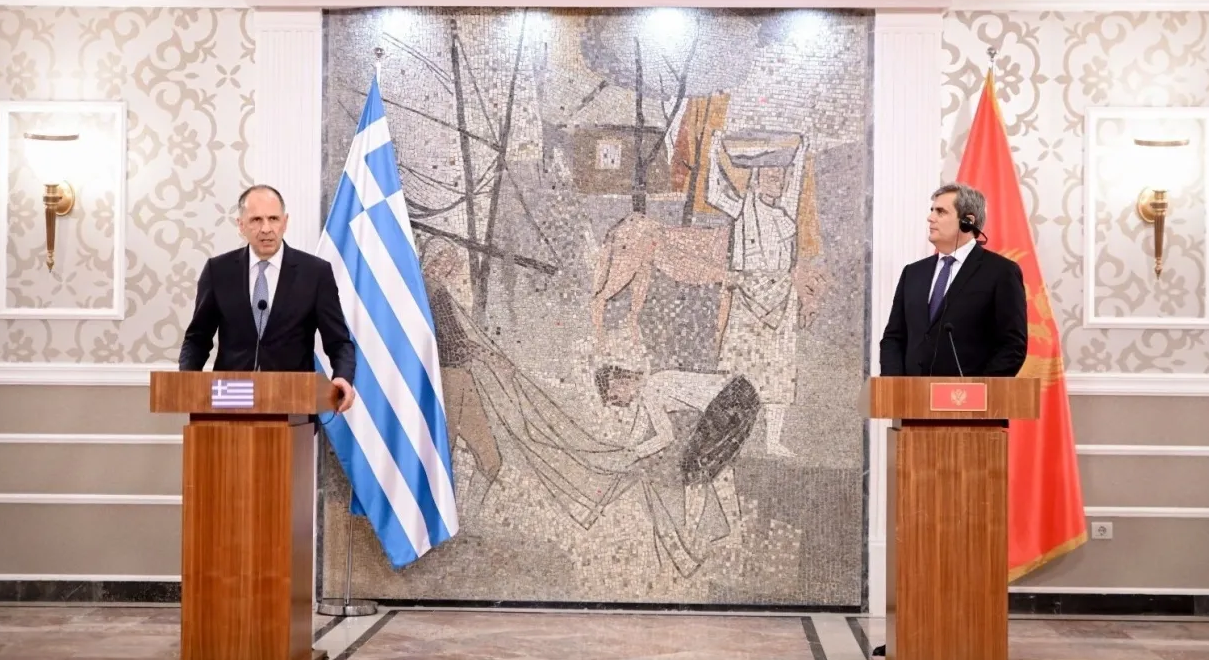
The Greek government is considering ways to speed up Montenegro’s accession to the European Union during its presidency of the EU Council in the second half of 2027, as part of a wider strategy for the Western Balkans.
“Athens sees an opportunity to revive its legacy of enlargement,” George Tzogopoulos, senior fellow at the Hellenic Foundation for European and Foreign Policy (ELIAMEP), told Euractiv.
Greek Foreign Minister Giorgos Gerapetritis visited Podgorica to discuss Montenegro’s path to the EU with his counterpart Ervin Ibrahimovic and Prime Minister Milojko Spajic.
Greece will take over the next EU Council presidency in July 2027 and aims to help at least one Western Balkan country join the Union.
Athens hopes to build on the key role it played during its presidency in 2003, when it prepared the biggest enlargement of the EU since the Cold War.
Greek officials believe that Montenegro, which opened accession negotiations in 2012, is the most realistic candidate compared to other countries such as Serbia or Albania. The small population of around 600,000 inhabitants is seen as a factor that would bring relatively low economic and political costs to the Union.
Podgorica has called its initiative “28 of 28”, aiming to become the 28th member state of the EU by 2028.
The Minister of European Affairs of Montenegro, Maida Gorčević, said that the country should not wait too long for full membership. However, not all member states are willing to speed up the process, often raising technical and methodological obstacles.
EU leaders are expected to discuss enlargement at a summit in Brussels, while Athens is considering ways to facilitate Montenegro’s accession by the end of 2027, during its presidency.
