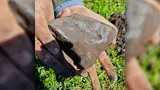
The meteorite referred to as Northwest Africa 12774, abbreviated NWA 12774, was discovered in the Sahara desert in 2019. It belongs to a rare group of meteorites called angrites. Of the more than 80,000 meteorites that have been found on Earth so far, scientists have classified only 68 of them as angrites.
Their rarity and unusual chemical composition make them valuable witnesses of the earliest history of the Solar System. Angrites were formed only a few million years after its birth, so they are among the oldest known volcanic rocks. Scientists consider them to be a kind of “geological archives” of a period from which very few direct traces have been preserved on Earth.
Photo: CU Boulder/Aaron Bell
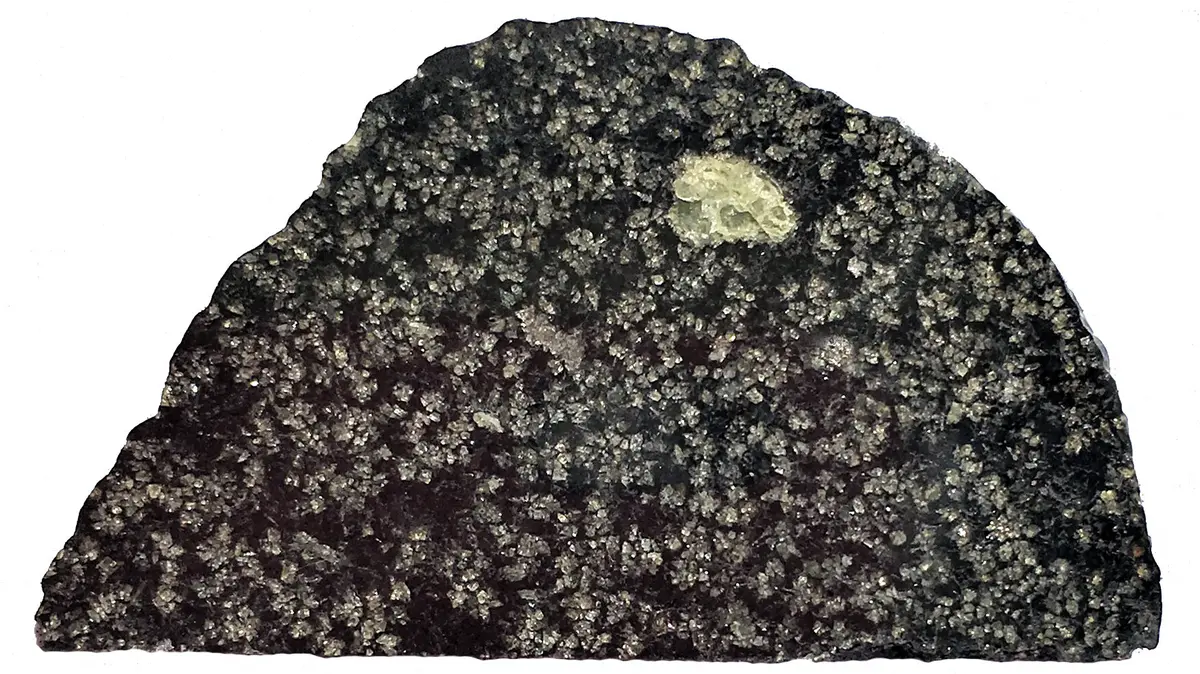
X-ray image of meteorite NWA 12774
Not an asteroid, but a planetary embryo
A new study published in the journal Earth and Planetary Science Letters focused on clinopyroxene crystals inside meteorite NWA 12774. They were exceptionally rich in aluminum, which the authors of the study say is a sign of formation under very high pressure. The research team therefore reconstructed the conditions under which these crystals could grow.
The result surprised the scientist. According to calculations, the clinopyroxene in NWA 12774 needed a pressure of at least 17.5 kilobars. For comparison: the pressure at the bottom of the Mariana Trench, the deepest known place on the ocean floor, reaches only one kilobar. According to scientists, such conditions could not have been created by an asteroid with a diameter of several tens or hundreds of kilometers. The mother body must have been much larger.
In addition, the crystals in meteorite NWA 12774 retained sharp edges that would not have been preserved during a long stay in the hot interior of the parent body. This suggests that they crystallized relatively close to the surface. In order for it to reach a pressure of 17.5 kilobars even at such a small depth, according to calculations, this body had to have a radius of over 1,800 kilometers. For comparison, the radius of the Moon is 1737 km.
When analyzing the meteorite, the scientists identified other minerals, such as olivine, in addition to clinopyroxene.
An extinct world from the early Solar System
What happened to this protoplanet is not certain. Many protoplanets and other bodies moved around the young Sun, which bumped into each other, merged or, on the contrary, shattered into smaller fragments. The terrestrial planets Mercury, Venus, Earth and Mars eventually emerged from such collisions.
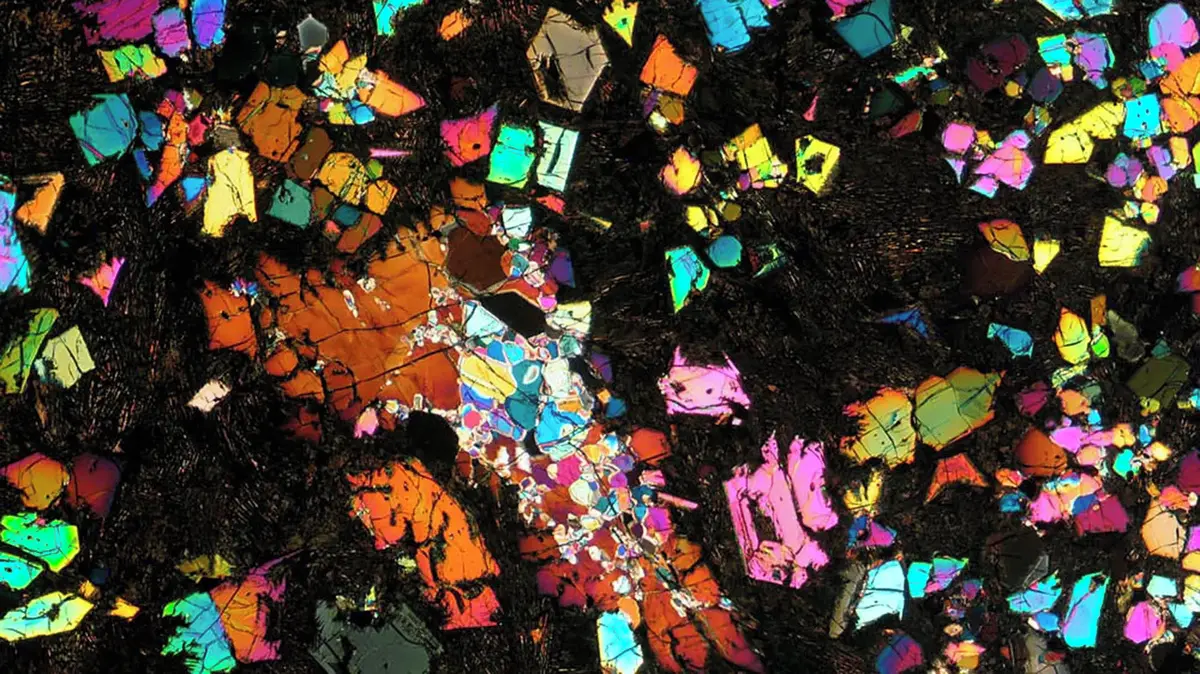
Photo: CU Boulder/John Kashuba
When viewed through polarizing filters, meteorite NWA 12774 resembles a kaleidoscope.
The parent object from which NWA 12774 originates may have been broken up in one of these collisions. Its parts could be scattered throughout the Solar System and one of the fragments could subsequently end up in the Sahara sand.
“It’s incredible to imagine that such a large cosmic body once existed,” study lead author Aaron Bell told the Phys portal. “We only know it existed because a few of its fragments accidentally landed on Earth.”
The colorful past of our solar system
Meteorite NWA 12774 thus broadens the idea of how diverse the early Solar System was. It was a dynamic environment full of temporary worlds, some of which disappeared before they could grow into a stable form.
The authors of the study also point out that NWA 12774 may not be the only evidence of a similar “lost world”.
“There are many meteorites in museum collections and research laboratories that have not yet been thoroughly explored. There were probably more similar protoplanets that we do not yet know about,” added Aaron Bell for the Space portal.
🚨 SCIENTISTS HAVE FOUND A FRAGMENT OF ONE OF THE EARLIEST PLANETARY BODIES IN THE SOLAR SYSTEM. WE MAYBE HOLDING A FRAGMENT OF AN ALIEN PLANET.
A rare meteorite discovered in the Sahara Desert, known as Erg Chech 002, has been dated to roughly 4.566 billion years old making it… pic.twitter.com/X4kDTpCr8m
— TheNewPhysics (@CharlesMullins2) June 7, 2026
What is an asteroid and what is a protoplanet?
Asteroid they weren’t planet is a small body orbiting the Sun that never grew to planetary proportions. Most asteroids are located in the belt between Mars and Jupiter. They have an irregular shape and their size ranges from a few meters to hundreds of kilometers.
Protoplanet is the larger seed of the planet. It was formed by the gradual merging of dust, stones and smaller bodies in the young Solar System. Some protoplanets continued to grow and became today’s planets, others were broken up during collisions or absorbed by larger bodies.