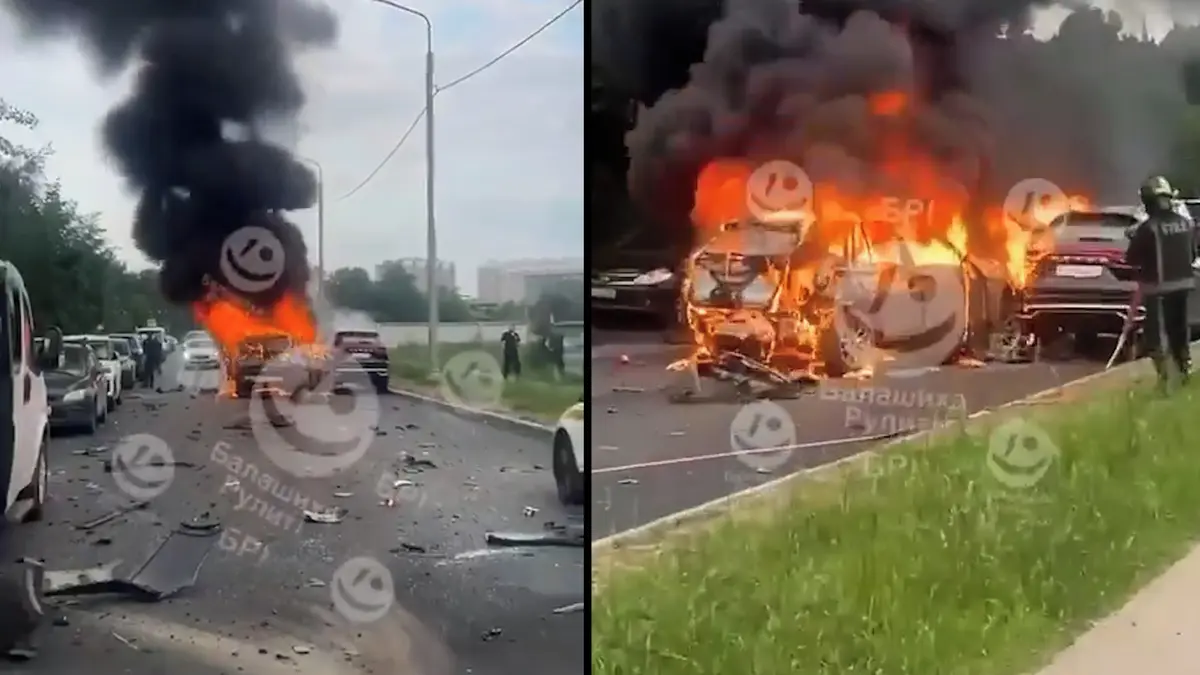
Telegram channel Shot reported that the explosive device was placed behind the driver, who suffered a shrapnel wound to the chest after the explosion. “The explosive device exploded seconds after the BMW X3 left the parking lot. The car traveled about 50 meters,” the post reads. According to Shot, the explosive weighed about 400 grams, the Russian server Kommersant says about half a kilogram.
An eyewitness said that the car drove a few meters in the parking lot before the bomb exploded. The burning car subsequently crashed into a car parked on the right side of the street.
According to the VČK-OGPU blogger, Colonel Davydov should have died in the explosion. “According to preliminary information, the victim of the explosion that occurred this morning is the head of the Main Missile and Artillery Command of the Ministry of Defense of the Russian Federation, Damir Davydov. He lived in the city of Balashikha,” he wrote, adding that Davydov bought the BMW X3 car in 2024 from a businessman from Russia’s Vladimirov region. However, this information cannot be directly independently verified.
The Astra Telegram channel reported that the Russian Investigative Committee had opened criminal proceedings. “At the moment, investigators and criminalists together with operational units are inspecting the scene of the crime, several necessary forensic expert opinions, including medical and pyrotechnic, will be ordered in the near future,” Astra quotes the Russian authorities.
The channel added that the explosion occurred in the Aviatorov quarter, which the Russian authorities built for soldiers in 2011-2013. According to the VČK-OGPU, Davydov was supposed to live in the town of Balashicha.
Davydov’s name became public after Russian military documents were leaked to the public during the disputes between mercenary chief Yevgeniy Prigozhin and the Russian Ministry of Defense. Davydov was then supposed to be directly responsible for the distribution of ammunition in the Russian army in Ukraine.
There was also an explosion in the same district last April. At that time, the deputy chief of the main operational administration of the Russian General Staff, Lieutenant General Jaroslav Moskalik, did not survive her. The Russian authorities identified Ignat Kuzin as the perpetrator, who they subsequently presented as a Ukrainian agent.