
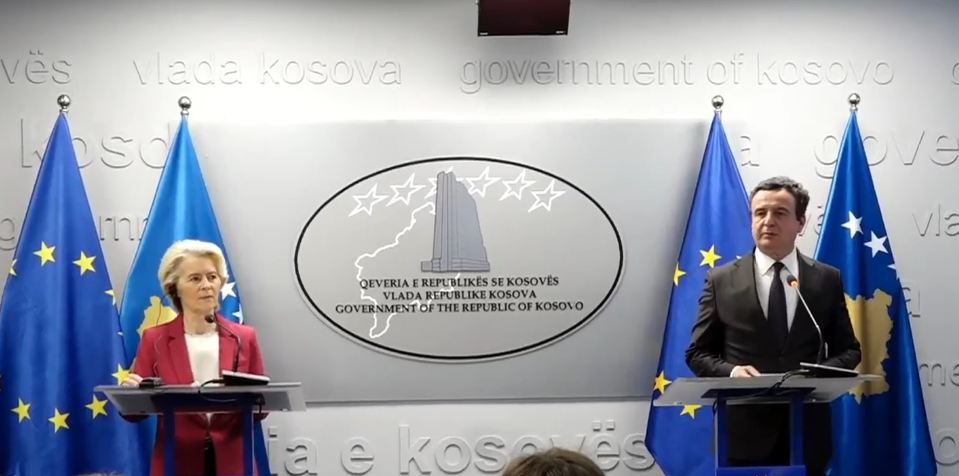
The Prime Minister of Kosovo, Albin Kurti, together with the President of the European Commission, Ursula von der Leyen, during the joint conference, emphasized that Kosovo’s European path depends on progress in reforms and respect for the rule of law, underlining that the independence of the judiciary must remain inviolable.
Asked about the proposed bill to amend the Law on Specialized Chambers, she said that it is up to Kosovo to decide on the steps it wants to take, but added that it is essential that the judicial system remains independent.
For his part, Prime Minister Albin Kurti thanked the president of the European Commission for his continuous support to Kosovo and its citizens, appreciating her frequent visits to the country. He said that since their first meeting, Kosovo has made significant progress in democracy, rule of law, fight against corruption and protection of human rights.
Kurti stated that independent international evaluators have confirmed Kosovo’s democratic progress, emphasizing that the country has experienced one of the fastest increases in democratic indicators in the region during the last decade.
“While there is an electoral autocracy in our region of South-Eastern Europe, we have an electoral democracy“, Kurti said, adding that the elections in Kosovo are free, fair and competitive.
In a humorous moment, he said that elections should be held once every four years and not twice in one year, smiling at Von der Leyen.
The Prime Minister emphasized that Kosovo remains committed to the values of Article 2 of the Treaty on the European Union and that the citizens’ support for European integration continues to be among the highest in the region.
Speaking about security, Kurti declared that Kosovo ranks among the safest countries in Europe. According to him, nine out of ten citizens feel safe walking alone at night, while the greatest improvements in security and rule of law have been achieved in the north of the country.
As for economic development, he said that Kosovo’s economy continues to grow by about four percent per year, while the public debt remains among the lowest in Europe.
Kurti also mentioned the social measures undertaken by the government, including allowances for children and mothers, the increase in pensions and the minimum wage, stressing that the benefits of economic growth have been shared with the citizens.
He reiterated that Kosovo is fully harmonized with the foreign and security policy of the European Union, including support for sanctions against Russia after the aggression against Ukraine.
At the conference, Kurti also spoke about the EU Growth Plan for the Western Balkans, announcing that the Government of Kosovo has approved ten of the twelve laws that had to be processed by June and has already sent them to the Assembly. He expressed his belief that the deputies will approve them quickly, so that Kosovo does not lose the European funds dedicated to the reforms.
During the meeting with Von der Leyen, the prime minister requested the support of the European Union for some important integration steps.
He said that he requested Kosovo’s membership in the Common Transit Convention, as well as integration in the European standardization organizations and the European accreditation framework.
According to him, these processes would facilitate the circulation of goods between Kosovo and the countries of the European Union, reduce costs for businesses and bring the Kosovar economy closer to the European single market.
Kurti also requested that the European Commission support the granting of candidate country status to Kosovo and recommend to the Council of the European Union seeking the Commission’s opinion on Kosovo’s application for EU membership, recalling that in December it will be four years since the submission of the application.
In the part of the conference dedicated to the last decision of the Specialized Chambers in The Hague, Kurti said that there are three elements that should be emphasized in the international arena.
According to him, the claims about the so-called “Yellow House” and organ trafficking were not part of the indictment, the accusations of crimes against humanity and widespread and systematic attacks against the civilian population have been dropped, while the Specialized Chambers themselves have emphasized that the Kosovo Liberation Army is not on trial and that the decision does not intend to call into question the legitimacy of the liberation war.
However, the prime minister expressed objections to some of the conclusions and sentences imposed, which he said contain factual, historical and legal errors.
He expressed the expectation that these issues will be addressed and corrected during the appeal process.
“Justice must be impartial and must be seen and experienced as such”, said Kurti, adding that Kosovo continues to demand justice for all victims of the war, including about 20 thousand victims of sexual violence, as well as the punishment of all perpetrators of crimes without distinction. He emphasized that the creation of narratives that equate responsibility and guilt for crimes committed during the war should not be allowed.
