
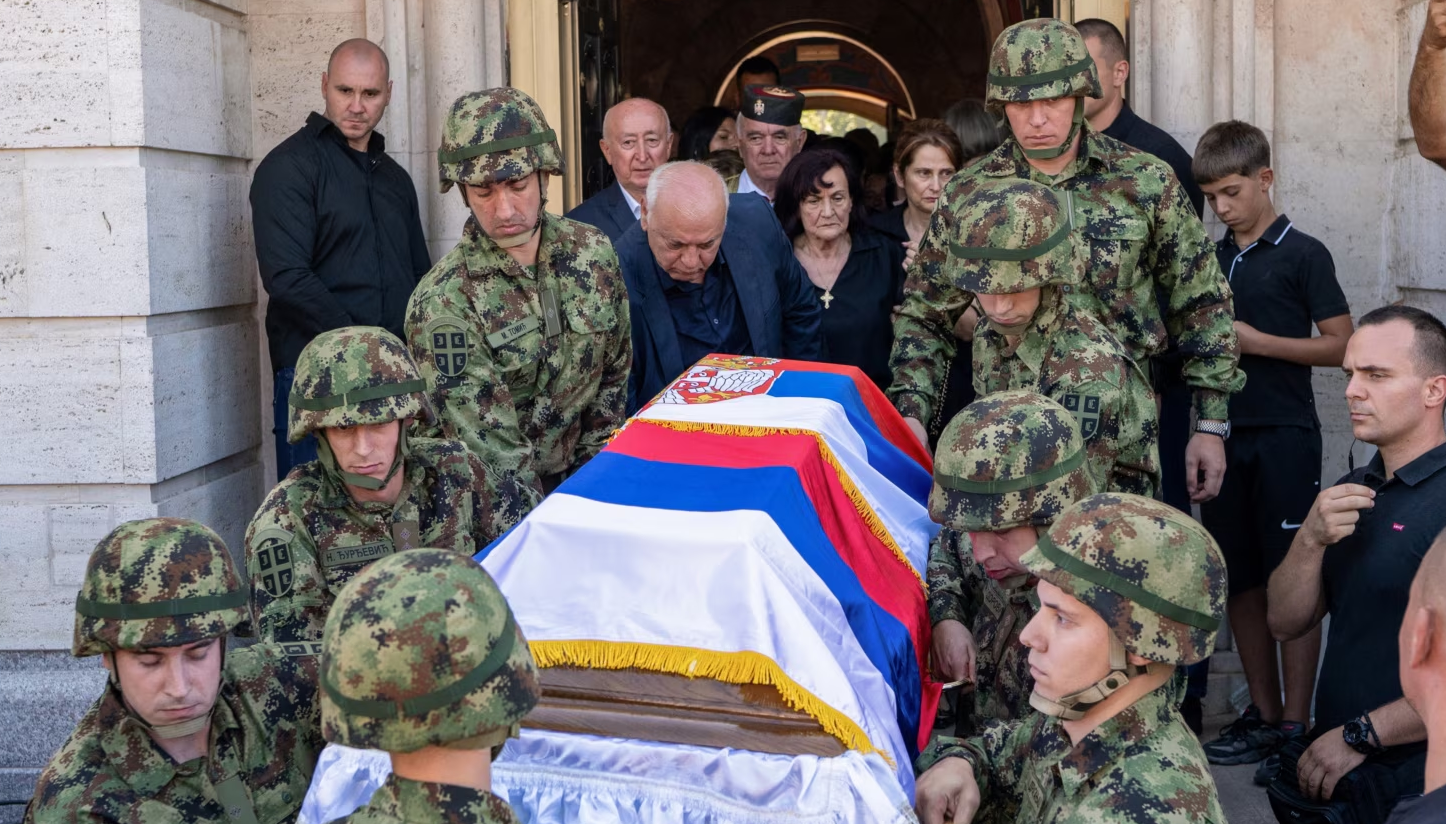
The former commander of the Army of the Republika Srpska, Ratko Mladić, convicted by the Hague Tribunal for genocide and other war crimes in Bosnia and Herzegovina, was buried on Monday in Belgrade with state and military honors. Mladić, who died on August 27 in The Hague while serving a life sentence, was buried in the Topčideri cemetery.
The ceremony was accompanied by salute shots and farewell speeches, in which his past during the war was glorified. In the presence of members of the Serbian Army, political leaders of the Republika Srpska and Serbian officials, those present chanted Mladic’s name and carried his coffin with applause. The European Union and the United States warned that honoring and glorifying persons convicted of war crimes is unacceptable.
Porphyry led the funeral ceremony
Mladic’s coffin was exposed during the day in the Church of St. Luke in Belgrade, where the funeral ceremony was led by the head of the Serbian Orthodox Church, Porfirije. During the ceremony, where members of the honor guard of the Serbian Army stood guard, prayers were made that “General Ratko be forgiven for the sins committed intentionally and unintentionally.” Porfirije said that his name “will remain deeply embedded in the memory and the prayers of the majority of the Serbian and Orthodox people”. He also said that the Serbian people “have deep gratitude” towards Mladic, as they see him as a “soldier and commander who, in a difficult time, stood at the head of his people’s army”.
What was Ratko Mladic sentenced for? Who paid tribute to Mladic?
To pay homage to Mladic, in Belgrade were, among others, the member of the Presidency of Bosnia and Herzegovina, Zelka Cvijanovic, the leader of the Alliance of Independent Social Democrats, Milorad Dodik, the president of the Republika Srpska, Sinisha Karan, the prime minister of this entity, Savo Minic, as well as other ministers and deputies of the Republika Srpska.
Among the officials was the Minister of Labor and Protection of War Veterans and Invalids of the Republika Srpska, Radan Ostojic, as well as Aleksandar Vulin, a member of the Senate of the Republika Srpska and former minister in the Government of Serbia, sanctioned by Washington due to his ties to Russia.
The Minister of Culture of Serbia, Nikola Sellakovic, and the Minister of Public Investments, Darko Gllishic, also paid tribute to Mladic. Pro-government media in Serbia reported that the son of the president of Serbia, Danillo Vucic, and the Russian ambassador in Belgrade, Aleksandar Bocan-Harchenko, were also present.
The Serbian Minister of Defense, Bratislav Gasić, the Minister of Justice, Nenad Vujić, and the Minister without portfolio, Nenad Popović, also attended Mladić’s funeral. Among those present was the mayor of Banja Luka, Drashko Stanivuković, as well as members of the branch of the Russian motorcycle group “Night Wolves”, known for their support of the Kremlin. The president of Serbia, Aleksandar Vučić, did not attend the funeral. who stated earlier that he could not be present due to the visit to Belgrade of the president of Uzbekistan, Shavkat Mirziyoyev. Vučić said that he had “done everything” for the burial to take place in a “dignified manner” and rejected criticism from the European Union for organizing Mladić’s burial with state honors.
Warnings from the US and the EU
US Senators Jeanne Shaheen, Chuck Grassley and Keith Self have called on authorities in Republika Srpska – the Serbian entity of Bosnia and Herzegovina – and in Serbia to distance themselves from Mladic’s burial.
In a joint statement, the senators recalled his responsibility for the genocide and other crimes in Bosnia and Herzegovina, emphasizing that they constitute some of the most inhumane crimes committed in Europe since the Second World War.
His forces were also responsible for the nearly four-year siege of Sarajevo – one of the longest sieges in modern history. His actions, taken together, constitute some of the most inhumane crimes committed in Europe since the Second World War”, the joint statement says. It is added that it is “deeply disturbing that Serbia has warned that Mladic will be buried with state and military honors”, and that the former leader of the Republika Srpska, Milorad Dodik, has called him a “fighter for Serbian freedom”.
“It is a desecration of the memory of his victims and of the region that still lives with the consequences of his campaign of ethnic cleansing, if a government celebrates or glorifies his death. The coming days will be a test of whether Serbia and Republika Srpska are ready to break away from the past and move towards European Union membership and Euro-Atlantic integrations, or will they allow the past to once again become an obstacle to a better future for their citizens,” it says. statement.
The US senators called on the Government of Serbia and the Government of Republika Srpska to refrain from any participation or association with the planned ceremonies and to ensure that “no public statement or official action portrays Mladic as anything other than what he was: a convicted architect of genocide.”
Two US congressmen, Greg Murphy and Marc Veasey, visited Potocar on Monday to pay tribute to the victims of the genocide in Srebrenica and to reaffirm the United States’ commitment to preserving the truth and promoting accountability.
The delegation of the European Union in Bosnia and Herzegovina said that the glorification of war criminals, genocide denial and revisionism contradict the most basic European values and that they have no place either in the EU or in the candidate countries for membership. The European Commissioner for Enlargement, Marta Kos, canceled the planned visit to Serbia, saying that glorifying a person convicted of war crimes and genocide in Bosnia and Herzegovina is incompatible with the values on which the road to the European Union is based.” “Serbia lost the opportunity to distance itself from Mladic’s legacy”
Jasmina Llazović, director of the Fund for Humanitarian Law in Serbia, said that what is happening in Belgrade seems like a big missed opportunity for Serbia to officially distance itself from Mladic’s legacy and his responsibility for the many crimes committed in Bosnia and Herzegovina.
“Serbia had the opportunity, although during the past years it has constantly stood by Mladic and several times gave guarantees in his favor, to now say that this is a man responsible for terrible crimes and that this country wants to distance itself from him“, said Llazovic.
She estimated that this is a consequence of the official policy of the culture of memory, which, according to her, “is based on the premise that Serbia has waged only defensive wars”. Llazovic.
According to her, it is clear that the state is behind all this – which is proven by the fact that Mladic is being buried with state and military honors, while the funeral service is being held by the highest leaders of the Serbian Orthodox Church.
“The Serbian Orthodox Church, since the 90s, has stood side by side with the people who planned and committed war crimes, so this is just the continuation of the official policy of the Serbian Orthodox Church, which has never distanced itself from the war crimes and from all the atrocities committed by the military and police structures of this state.”said Llazovic. For Mladic, on Saturday, September 5, a memorial ceremony was also held at the House of the Serbian Army in Belgrade.
It was attended, among others, by the Minister of Justice of Serbia, Nenad Vujic, and the President of Republika Srpska, Sinisha Karan.
The Youth Initiative for Human Rights in Serbia condemned what it described as a “misuse of state resources” during the transport of Mladic’s body and the announcement of a state memorial ceremony for him.
Ramet: Many Serbs find it difficult to accept that Mladic committed genocide
The American political scientist, Sabrina P. Ramet, says that the glorification of Ratko Mladic is related to the way societies construct and preserve narratives about their past, even when they conflict with the facts of the authenticated from the courts. According to her, history textbooks in Serbia convey the narrative that the country has acted righteously and has been the victim of the injustices of others – a narrative that, she says, is also reinforced by the media under the control of President Aleksandar Vučić. decisions based on evidence”, says Ramet for Radio Free Europe.
She says that international justice can determine a person’s criminal responsibility, but this does not necessarily mean that it will also change the way they are remembered by a part of society. “For people who have been attached to a certain narrative, it is often extremely difficult to abandon it, even when there is a lot of evidence that disproves it,” says Ramet, a professor at the Norwegian University of Science and Technology (NTNU) in Trondheim.
According to her, war narratives can also be inherited by generations that have not experienced the conflict: studies in different countries have shown that even the grandchildren of the generation that experienced the war can inherit the feeling of suffering and anger. In the days after Mladic’s death, in several cities of Serbia and in the entity of Bosnia and Herzegovina, Republika Srpska, rallies were held in his memory. The largest rally was held in Banja Luka on 1 September.
“Only the truth matters”: Victims of Srebrenica and Sarajevo speak about Mladic
In the media narratives in Belgrade and Banja Luka, Mladic was presented as a victim of the Hague Tribunal, which did not allow him to go to Serbia for medical treatment, while his sentence and the victims were barely mentioned. The OSCE Mission in Bosnia and Herzegovina said on Monday that it was concerned about the live broadcast of the memorial ceremony for Mladic by Radio-Television of the Republic of Serbia (RTRS), during which the speakers of praised him several times. The OSCE called on the Communications Regulatory Agency to assess this report without delay and “react proportionately to any violations found”.
“Respecting the facts proven by the courts and the dignity of victims and survivors is essential for responsible journalism, reconciliation and lasting peace in Bosnia and Herzegovina”, said in response.
Tributes to Mladic were held even though the criminal law in Bosnia and Herzegovina prohibits and punishes the public denial of genocide, crimes against humanity and war crimes certified by final court decisions, as well as the glorification of persons finally convicted of war crimes. These offenses are punishable by up to five years in prison.
