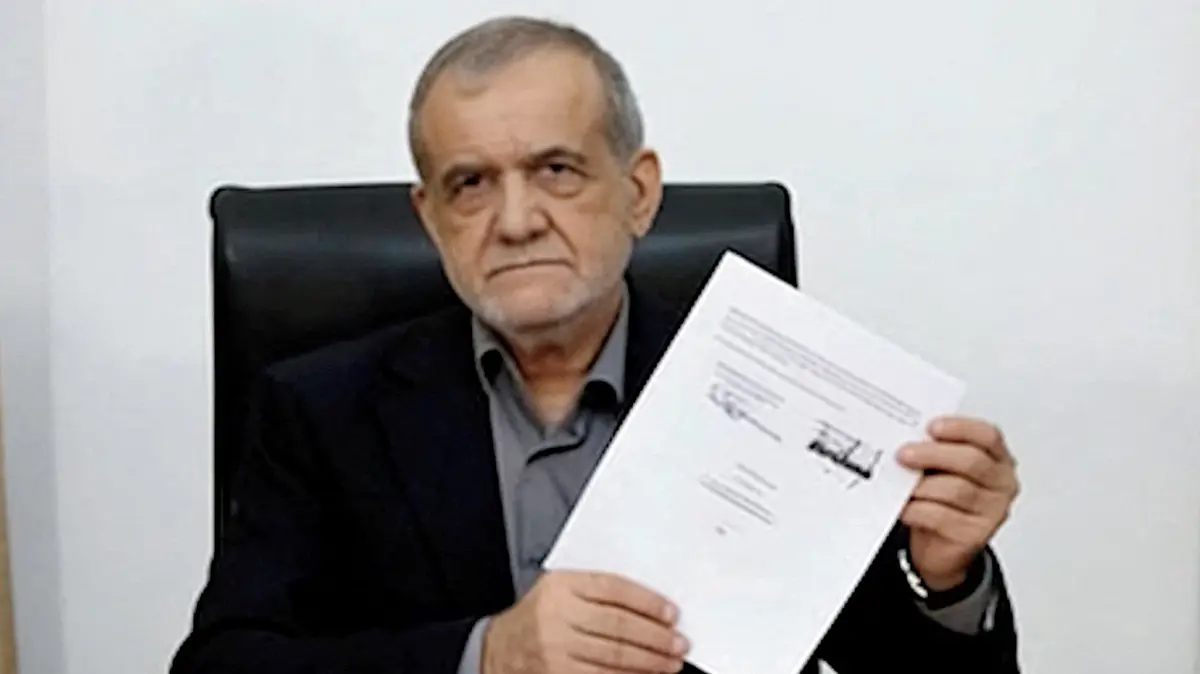
“If there were no missiles that we have for defense, Israel and the United States would crush Iran just like they did Gaza, they would have no mercy for either the old or the young,” said Pezeshkyan, according to Al-Arabiya, during a visit to Pakistan on Tuesday, a key intermediary in the talks between Tehran and Washington.
“We will never negotiate with anyone, under any circumstances, simply never, about our defense capabilities,” he said. “That’s why there will be no negotiations on Iran’s ballistic program,” he added.
Before the war, the administration of US President Donald Trump sought to add a ballistic missile development and production program, as well as support for Shiite militias operating in Iraq, Syria and Yemen, to negotiations on Iran’s nuclear activities. In recent days, Trump seems to have softened his stance on the issue of Iran’s ballistic missiles.
Trump changed his mind
“They must have some (missiles) because others have them too. Should I allow Saudi Arabia to have missiles, but not Iran? That’s not how it works,” Trump said last week at the G7 summit in Evian, France.
According to available information, the longest range of Iranian missiles with a flat flight path of Soumar is 2,500 kilometers, Ghadr, Sedjjil and Khorramshahr can handle 2,000 kilometers and Emad 1,700 kilometers.
Medium-range missiles Shahab-3 with a range of 1300 kilometers, Kadr 380+, which can handle 1000 kilometers, Kiam-1 with a range of 800 kilometers, together with long-range missiles were dangerous both for Israel and for American facilities in Qatar, Bahrain, Kuwait, Saudi Arabia or the United Arab Emirates.
Short-range ballistic missiles, from 150 to 700 kilometers, were used for nearby military targets, and Iran used them in rapid regional strikes. Among the basic ones are systems with older missiles Šahab (with a range of 150 to 300 kilometers), Fateh (500 kilometers) and Zolfaghar (700 kilometers). Most of these systems are “equipped” to launch salvos, which makes it significantly more difficult to react to their potential attack.
US-Israel war against Iran
The war between the US, Israel and Iran erupted in full force on February 28, 2026. The United States, codenamed Operation Epic Fury, and Israel Roaring Lion launched massive airstrikes on key cities and nuclear facilities in Iran.
At the very beginning of the operation, the supreme leader of Iran, Ali Khamenei, and the commanders of the Iranian Revolutionary Guards were killed in airstrikes.
Iran responded with massive rocket and drone shelling of Israel, American bases in surrounding countries and other regional targets, including refineries. Pro-Iranian militias (terrorist Hezbollah from Lebanon and Shia rebel Houthis from Yemen) also joined the fighting.
During March, the US and Israel hit thousands of Iranian military targets. The key moment was the strike on the nuclear facility in Natanz, to which Iran responded with missile attacks on Israeli targets in the Negev desert.
The Israeli cross-border attacks, which were retaliation for shelling led by Hezbollah, grew into a new Lebanon war. It fully erupted on March 2, 2026. Israel launched a ground offensive and created a buffer zone in Lebanon that extends to the Lítání River.
During the fighting, Iran blocked the strategic Strait of Hormuz, which crippled the transportation of oil, liquefied gas and other commodities. This was followed by a dramatic increase in fuel prices.
After roughly six weeks of intense mutual shelling, a cease-fire was announced on April 8, 2026, but Israel did not observe it in Lebanon.
The subsequent mediated peace negotiations culminated on June 17, 2026 with the signing of a memorandum of understanding between the US and Iran, which started a 60-day deadline for negotiating a definitive peace agreement.
Ship traffic in Hormuz began to slowly return to normal. Israel eased the shelling in Lebanon, but only after strong pressure from the United States.