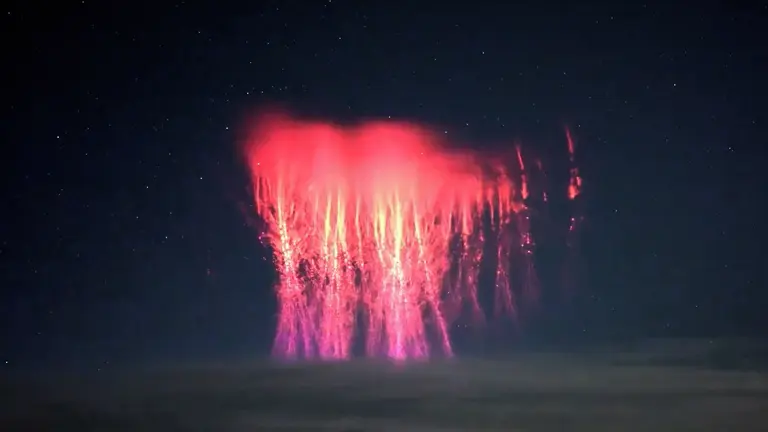
The published images show dozens of individual fibers and discharge structures that create an extensive complex of red sprites. Such expressive manifestations belong to the most impressive forms of transient light phenomena.
Capturing this phenomenon is not at all easy. In addition to good technique and a considerable amount of patience, you also need luck. In this case, however, the photographer was blessed not only with extremely extensive activity of red sprites, but also with very favorable observation conditions.
“I was able to capture images of red gnomes near the shores of Puma Yumco Lake in Lhokha Prefecture, Tibet, at an altitude of over 5,000 meters. The air here is extremely thin and clean, which makes it possible to photograph transient light phenomena at great distances,” Shuchang said on his Instagram account.
By a remarkable coincidence, a Czech photographer also captured another red sprite on the same day, which we reported on in a recent article. However, the Tibetan event was particularly interesting due to the extraordinary scope and clarity of the conquests. That is why the images quickly spread on social networks and meteorological servers all over the world.
Although red sprites have existed as long as storms themselves, science only confirmed their existence in the late 1980s. Today we already know that a whole series of electrical processes are taking place above strong storms, reaching deep into the upper layers of the atmosphere. In addition to red sprites, they include, for example, blue jets or elves.
The event over Tibet is a reminder that even in the 21st century, the atmosphere can offer phenomena that seem almost alien, even though they are taking place directly above our heads.
Red gnomes
Red gnomes, English red spritesare short-term electrical discharges occurring high above active thunderstorms. Unlike classic lightning, which we observe inside storm clouds or between the cloud and the ground, sprites appear at heights of approximately 50 to 90 kilometers above the earth’s surface.
They occur most often after very strong positive lightning, which transfers an extraordinary amount of electric charge between the storm cloud and the ground. The subsequent change in the electric field can cause a large-scale discharge in the thin upper atmosphere. It is the excitation of nitrogen molecules that causes their characteristic red coloration.
Wraiths are only visible for a few milliseconds, but modern sensitive cameras and high-speed cameras allow us to capture their fascinating structure, including fibrous roots and branching formations resembling jellyfish.