The investigation into the accident has only just begun, but a recording of the communication from the tower shows that the firefighters in vehicle number 1 were allowed by the air traffic controller to cross the runway. They were called by the crew of a United Boeing 737 Max plane standing on the ground because they noticed a strange smell on board. The stewardess became ill, the website Open Magazine reported.
At that moment, the driver was simultaneously communicating with the crew of the Frontier company flying to Miami, the landing crew of the Southwest plane flying from Denver and the Delta crew from Detroit. He did not communicate with the crew of Jazz flight 646 from Montreal. The flight is referred to as Jazz 646 because it was operated by Jazz for Air Canada Express.
Permit for firefighters
The tower first enabled the start of the flight to Miami, according to the recording: “Frontier 4109, take off from runway 13.” Then she received a report from the Delta crew: “Towers, this is Delta 2603, ILS 4.” The manager was telling her to get ready. Then he asks: “What kind of vehicle is it that needs to cross the runway?”
He gets the answer: “Vehicle 1 with a crew.” Then comes the request: “Vehicle 1 with crew requests permission to cross runway 4 at delta point.” The delta point means the taxiway from which the runway is entered.
The air traffic controller from the tower then gives permission: “Vehicle 1 with crew, cross the four at the delta point.” Firefighters answer: “Vehicle 1 with a crew is crossing the four on the delta.”
The tower then turns to the flight to Miami: “Frontier 4195, stop there, please.”
This is followed by the several times repeated call “stop, stop, stop”, which acts as a message for Frontier 4195. In addition, the situation seems quite chaotic.
But suddenly the dispatcher says: “Vehicle 1, stop. Stop, stop. Vehicle one, stop.” Intermittent and then continuous honking can be heard in the background.
The dispatcher turns to the flight from Detroit: “Delta 2603, go around (a maneuver in which the pilot breaks off the landing and quickly climbs to a safe height, editor’s note), runway heading, climb to 2000.”
Only then does he contact the plane from Montreal for the first time: “Jazz 646.”
Crash on the runway
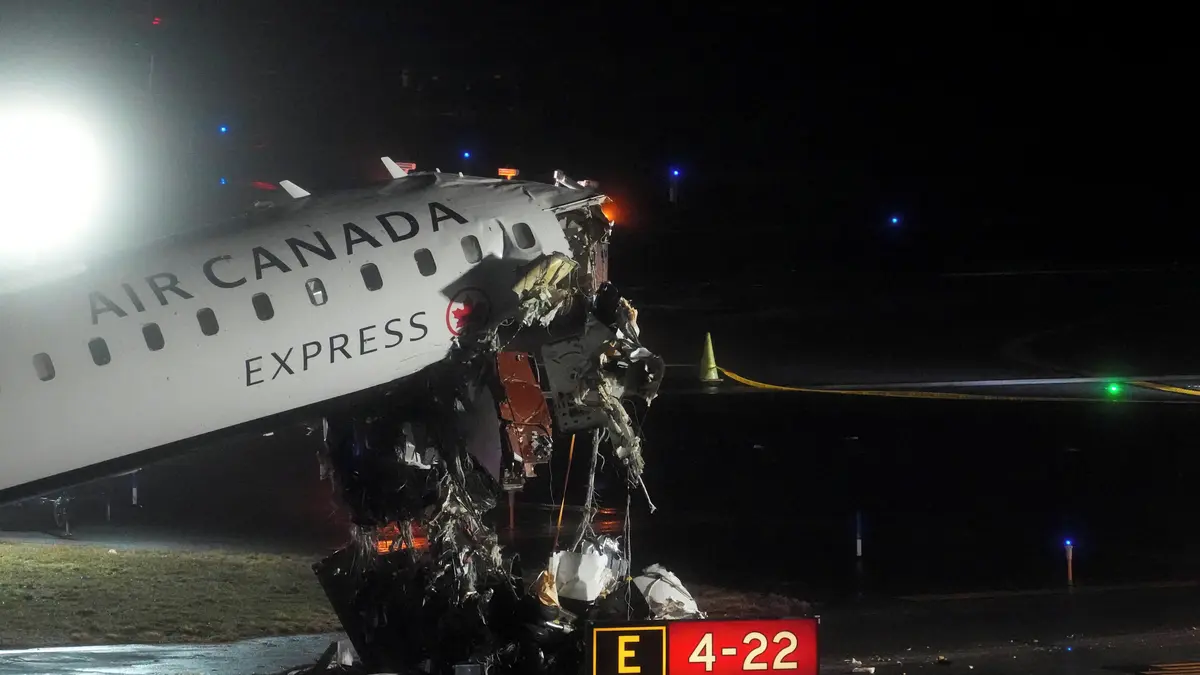
It is not enough to add more, because the impact can be heard. The dispatcher then speaks to the same crew: “Jazz 646, I see you collided with a vehicle, just stay in position. I know you can’t move. There are (emergency) vehicles responding to you now.” There is no response.
The tower is then asked: “Is the runway closed?”
The controller replies: “Delta 2603, go around, runway heading, climb to 2000.” The Delta crew does it again.
Subsequently, the crew of the fire engine turns to the tower: “This is vehicle 32, runway 4 is closed, yes?”
“Yeah,” confirms the dispatcher, “go to Runway 4 now and continue on Runway 4, you have access there.”
It is not yet clear why the dispatcher did not pay attention to the landing flight from Montreal. The Open Magazine website reports that LaGuardia Airport was dealing with bad weather before the incident.
“I messed up”
The NBC station also published another part of the communication in the tower after the accident. One of the controllers says that “it was not nice to watch”.
To which another dispatcher replies, “Yeah, I know, I was there, trying to fix it, we had another emergency before. I messed up.” By another emergency situation, he meant the need to intervene at the Boeing 737 Max of United Airlines, where a strange smell was felt.
The other one tells him: “No man, you did the best you could do.”
The Delta flight from Detroit was diverted to JFK airport, where it landed at half past one in the morning.
The crash claimed the lives of both pilots. Another 41 people were injured, according to the airport management, NBC reported. Among them are other crew members, passengers and firefighters. Some are in serious condition, but the airport did not state the number of seriously injured.
The go around maneuver is performed in cases where the plane cannot be landed safely. Typically, it can be, for example, poor visibility on the runway, an object on the runway, an unstable approach to the runway, etc. After climbing to the desired height, it returns to the approach and tries to land again. The crew can perform the maneuver at their own discretion or at the command of the controller.
Photo: Shannon Stapleton, Reuters