
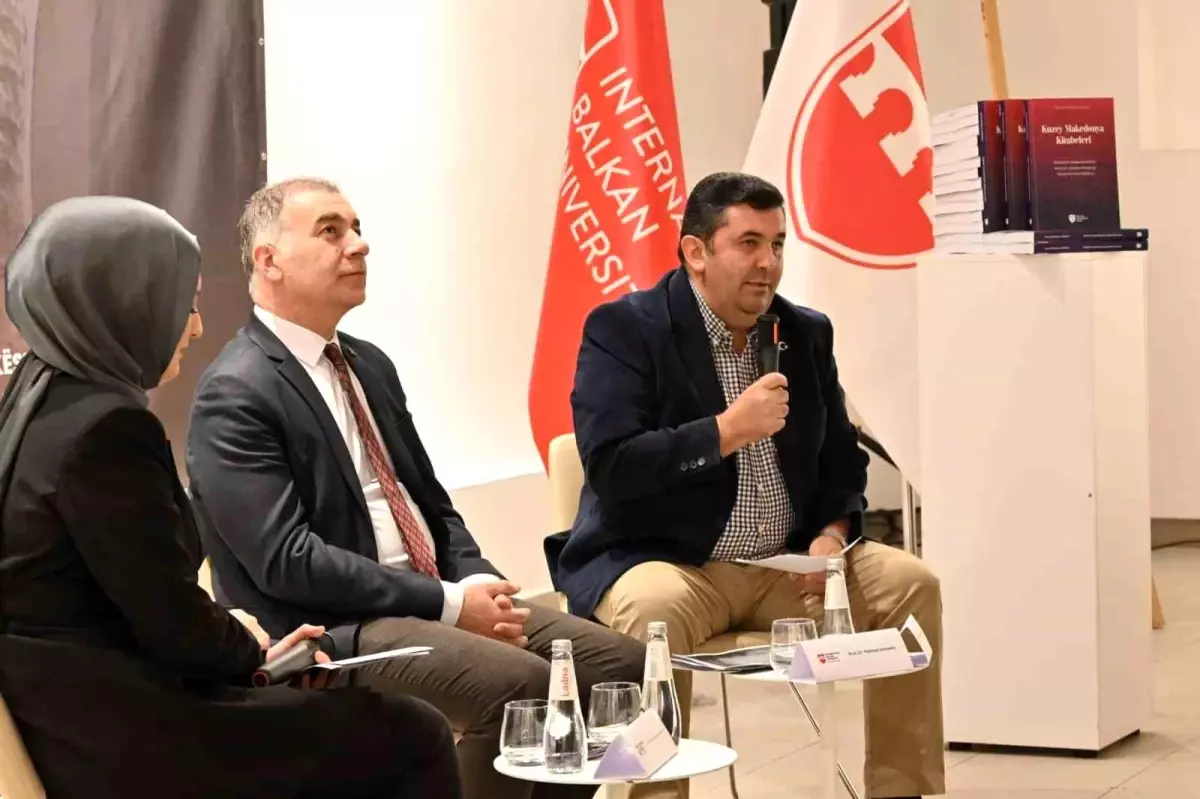
A new one has been added to the efforts carried out in order not to erase Turkish traces in the Balkans, which is Türkiye’s gateway to Europe. Many Ottoman works and monuments that go unnoticed as you walk past them; Turkish traces in the Balkans will continue to be kept alive with the project, which was put into operation with the aim of not disappearing into the depths of history and to keep the forgotten values alive.
Bilateral relations between Türkiye and the Balkan countries, which date back to ancient times and are very deep-rooted, continue to be maintained today. A new one has been added to the efforts carried out to preserve Türkiye’s traces in this geography.
120 inscriptions were examined and translated into 4 different languages
The ‘North Macedonia Inscriptions Project’ is being carried out in a very comprehensive manner to unearth Ottoman artifacts in Macedonia. Giving information about the subject, International Balkan University Rector Prof. Dr. Lütfi Sunar said that this project was carried out to make meaningful works that remained silent for many years in the Balkans visible and understandable again. Sunar said, “Our project, which aims to reveal, read, translate the inscriptions of Ottoman works in North Macedonia and replace the lost ones, is at the very center of the mission of the International Balkan University. IBU, which ensures contact between cultures, was established with the belief that education is the most powerful tool to build bridges between the past and the present and between the different cultures that enrich this region. The North Macedonian Inscriptions Project started with an observation rather than an idea. Alert and sensitive travelers in the Balkan cities It is impossible for someone not to see the often obscured, sometimes unnoticed inscriptions engraved on the walls of the Ottoman architectural works that bear witness to history. We created a team to record, read, translate and interpret the inscriptions of the Ottoman period architectural works in North Macedonia. We examined approximately 120 inscriptions, using both the existing literature and hard-to-reach sources, along with the findings made in the field. It was shaped as an epigraphy, history, art history and cultural heritage project. By meticulously deciphering these texts and re-presenting them in four languages, in Turkish, Albanian, Macedonian and English, we are doing more than academic archeology and building a common memory platform. The outcomes of this project show us that history is not a finished thing, but a living space of dialogue. By understanding the past in a nuanced way, we can develop more empathy, respect and cooperation in the present. “It is a concrete expression of our determination to make it the basis of understanding and a source of common pride,” he said.
“The silent texts on the stones gained meaning”
Many works of art in Skopje, the capital of North Macedonia, whose stories have not been carried to the present day, whose spirit has faded away and over time have been buried on dusty historical shelves, are being revived with this project. The spirit of the stories that have remained silent for years is being brought to light again. Sunar said, “The most valuable achievement in this process was the new meaning of the silent texts on the stones. Each line showed the continuity of the Ottoman cultural heritage in the Balkans and established a new cultural bond between the past and the present. Thus, the project was noted in history not only as a document work but as an attempt to re-read, give meaning and share a memory.”
The ceremony held at Mustafa Pasha Mosque in North Macedonia to officially launch the implementation process of the project was attended by North Macedonian Parliament Speaker Afrim Gaşi, North Macedonian Deputy Salih Murat, Yalova University Rector Prof. Dr. Mehmet Bahçekapılı, many guests attended.
Following the ceremony held at Mustafa Pasha Mosque, an exhibition and panel were held within the scope of the project in Skopje Çifte Hamam. IBU Secretary General and Turkish Teaching Department faculty member Assoc. Dr. In the panel moderated by Seyhan M. İbrahimi; Prof. Dr. Mehmet Samsakçı and Prof. Dr. Ertuğrul Karakuş explained the project in detail.
In addition, within the scope of the exhibition, the book containing the project outputs and making a significant contribution to the cultural heritage of North Macedonia was also introduced. – SKOPJE
