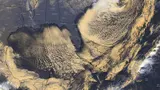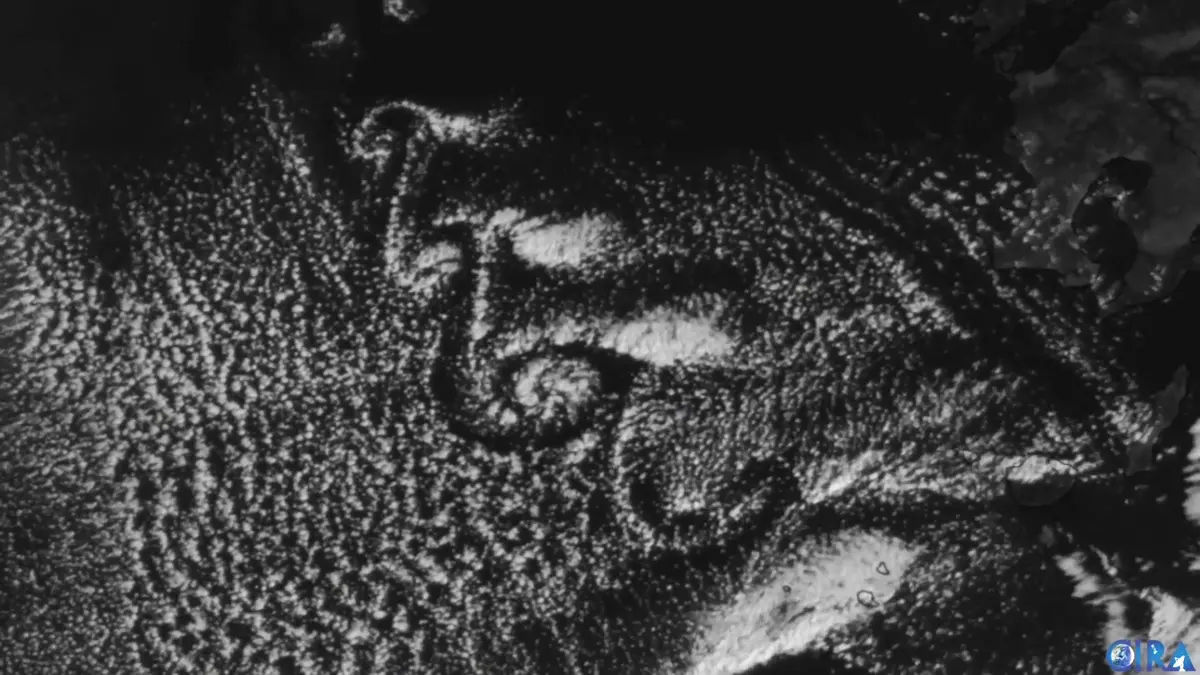
The images of the Japanese satellite come from the area of the East China Sea near the third largest Japanese island, Kyushu. The circular clouds formed in the lee of the South Korean island of Jeju and rotated from it in the direction of the northerly flow.
Kármán’s vortex path is an atmospheric phenomenon in which a regular series of alternating vortices is formed behind a significant obstacle, such as an island or a mountain massif, in a stable flow. An area of instability arises behind the obstacle, where the air flow alternately breaks off from one side and the other.
Moist sea air in rotating eddies condenses and creates cloud spirals, which are clearly visible on satellite images. The chain of these eddies can extend tens to hundreds of kilometers downstream.
Photo: Windy
Kármán’s eddy path in the East China Sea
The phenomenon is typically observable, for example, near the island of Jan Mayen, near Madeira or the Canary Islands in the Atlantic Ocean. It appears quite often in the East China Sea, especially during stronger northerly currents around isolated islands.
Kármán’s vortex paths are not only an aesthetically impressive phenomenon. They also provide information on the stability of the flow, wind speed and the character of the individual layers of the atmosphere. At the same time, they show how significantly even relatively small geographical features can affect air flow.