
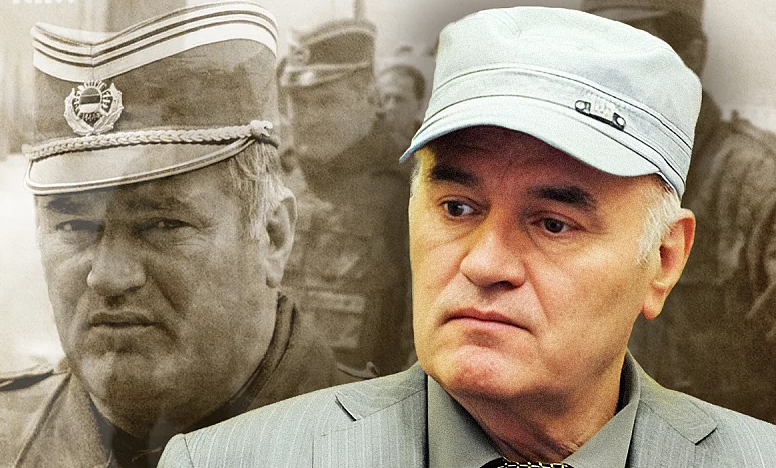
Ratko Mladic, former commander-in-chief of the Republika Srpska Army in the former Yugoslavia, died today at the age of 83 in a prison in The Hague, Serbian media reported.
Mladic had been ill for years, and his family and the authorities of Serbia and the Bosnian entity of RS have repeatedly requested his transfer to Belgrade for treatment, but the requests were rejected.
Punishment for war crimes
Originally from Kalinovik, Mladic was finally convicted in June 2021 by the International Criminal Court in The Hague for genocide in Srebrenica, persecution of the civilian population, extermination and murder, deportation, inhumane acts, terrorism and illegal attacks in Sarajevo, as well as taking UN soldiers hostage.
He was found guilty of 10 of the 11 counts of the indictment.
In international opinion, due to his crimes, Mladic was known as the “Butcher of Bosnia”, responsible for the death of over 8,000 men and boys in the Srebrenica massacre in 1995.
Escape and arrest
After the war, Mladic went into hiding for 15 years, avoiding justice. He was arrested on 26 May 2011 in the village of Lazarevo, near Zrenjanin, by the Serbian Security Agency and War Crimes Investigation Service.
His arrest came after international pressure, with Serbia offering monetary rewards for information leading to his capture.
However, many believe that he lived free for years under the protection of individuals from Serbian institutions.
Suspicions grew after the murder of two Serbian and Montenegrin Army Guard guards in 2004, an event linked to Mladic’s presence in the Belgrade barracks.
The legacy of crimes
The atrocities committed under his command, including the 1,425-day siege of Sarajevo where over 12,000 people were killed, remain an open wound in Balkan history.
Despite the many trials, Mladic continues to be seen as a hero by a part of society in Serbia and in the entity of RS in Bosnia.
His death in The Hague closes a long chapter of international justice, but the memory of the crimes he ordered lives on as evidence of genocide and terror against civilians.
