
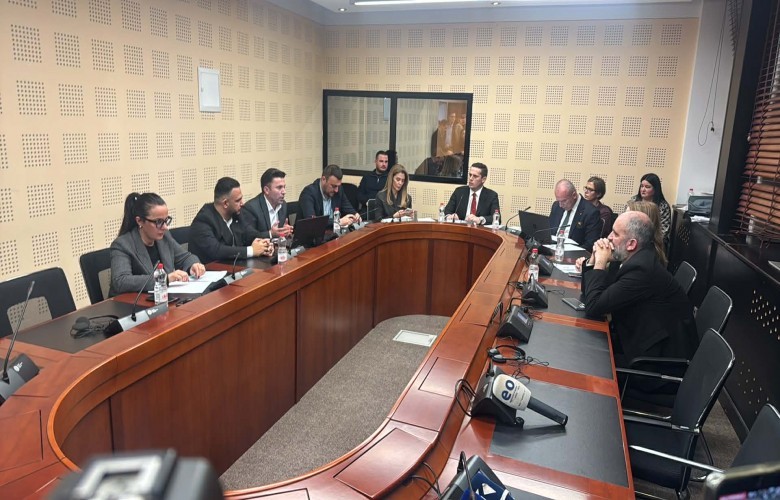
The Committee for Legislation in the Assembly of Kosovo approved this evening the constitutional changes proposed by President Vjosa Osmani, which pave the way for the election of the head of state by direct vote of the citizens.
With 6 votes in favor and 2 against, the initiative passed the first committee filter and is now expected to go to the plenary session. However, the meeting was characterized by fierce debates and deep polarization between representatives of the majority (LVV) and those of the opposition (PDK and LDK), highlighting a deep crisis of trust and political consensus.
The arguments of the majority: “Time for the people to speak”
The representatives of the Vetëvendosje Movement in the commission argued that the current circumstances make it necessary to pass this reform, which aims to avoid political bargaining in the Assembly. They relied on the fact that these amendments, although drafted in 2011, have already received the green light from the Constitutional Court.
Adnan Abrashi (LVV), emphasized that the constitutional assessment procedure is exhausted and the essential question remains the political will to give the sovereign the right to choose.
“Should we, as deputies, advance democracy to such an extent that the citizens elect the head of the state without submitting to the interests of political parties?” he asked.
Vigan Qorrolli (LVV), requested that the commission focus on the content and not on peripheral procedures, emphasizing that as long as there is no new precedent, the assessment of the Constitutional Court remains functional.
Adnan Rrustemi (LVV), defended the urgent call of the commission, justifying it with the current political circumstances. According to him, the three essential elements (the authorized proposer, the assessment of the Constitutional Court and the double vote in the Assembly with 2/3) have been completed or are on the way to being completed.
The opposition against: “There is no constitutional crisis, but a political crisis”
On the other hand, the opposition representatives described this move as an attempt to cover up the failure to find a political compromise for the election of the president, using the Constitution as a tool for short-term interests. The votes against came from members of the Democratic Party of Kosovo (PDK), Përparim Gruda and Blerta Deliu-Kodra.
The Chairman of the Commission, Pëparim Gruda (PDK), emphasized that the 2011 amendments procedure is a flagrant violation of the Assembly Regulations. According to him, the amendments should be reviewed within 7 days after the decision of the Constitutional Court. Furthermore, he noted that the 2011 Constitution has changed substantially, having over 20 new amendments and dozens of new interpretations by the Court itself.
Deputy Blerta Deliu-Kodra (PDK) declared that Kosovo does not have a constitutional impasse, but suffers from the lack of a parliamentary majority.
“The constitution cannot be changed to solve anyone’s personal interests. Kosovo has a crisis to ensure political agreement and consensus.”she said.
LDK deputy, Jehona Lushaku, strongly criticized the urgency with which this process is being handled. She reminded that important constitutional changes require analysis and broad social debate, and not be used as a rescue tool during political crises.
What is expected to happen?
Despite the procedural and essential objections from the opposition, the majority votes in the committee have paved the way for the file to be sent to the plenary session. To be finally approved, these amendments need the support of 2/3 of all deputies of the Assembly of Kosovo, as well as 2/3 of the votes of deputies from the ranks of non-majority communities—a difficult mathematical challenge in today’s polarized political landscape.
