Brett Velicovich, an expert on military systems interviewed on Fox News, praised American technology, especially artificial intelligence: “We see how American artificial intelligence takes Iran’s reaction time, and that includes the use of AI for drone technology. This is no longer an AI theory. What is happening now is an AI-led battle.”
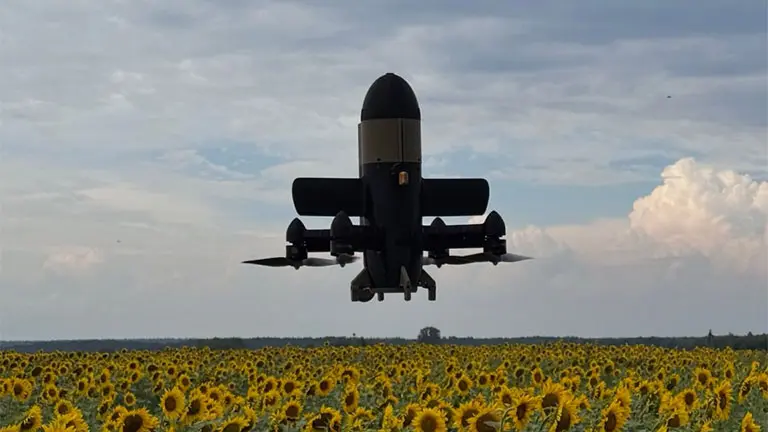
He mentioned drones only in passing. Apparently because the television used a shot of a drone attacking the Sting on the Iranian Shahid-136 or its Russian copy Geraň.
The reaction of the Ukrainian manufacturer Wild Hornets did not leave anyone waiting: “The shot captures the Sting – a Ukrainian fighter drone developed by engineers at Wild Hornets and used by the Ukrainian air defense to destroy Shahid series drones.”
Since the footage shows an attack on a martyr and Iran used these drones against American bases in the Middle East, the television used the video. For a long time, Ukrainians have been dealing with how to counter these drones, because Russia sends hundreds of them to Ukraine several times a night.
The manufacturer states that in seven months of deployment, Ukrainian Sting drones have already destroyed 3,000 Russian drones, and the effectiveness of their intervention is somewhere between 80 and 90 percent. At the same time, one costs 2,200 dollars (46,000 crowns), while Russian copies of the shahids cost about 80,000 dollars (1.7 million CZK).
Velicovich, however, devoted himself to AI tools, which process enormous amounts of intelligence from satellites and drones much faster than any human could ever do. “I am convinced that I am witnessing one of the most decisive changes to the rules of the game in American modern military history,” he concluded his statement.
He also mentioned in it that soon after the start of the operation, “the key figures are dead, they were eliminated even before they blinked”.
“This is what happens when world-class artificial intelligence is used in the hands of our best brave operators,” he continued, noting that the first attacks, including the one that killed Ayatollah Khamenei, were carried out by Israelis.
Anthropic controversy
Velicovich’s next appearance on Fox News shows why he talks so much about AI. It’s not just that AI is in the spotlight in general, because it’s developing rapidly and there’s an AI-related boom in the market that some investors and analysts see as an overblown bubble threatening to burst.
She found herself in the spotlight because, even before the attack, the US Department of Defense terminated the cooperation agreement with Anthropic when it refused to allow the use of its technologies for mass surveillance of households and fully autonomous weapons systems.
Suppliers of the US armed forces are no longer allowed to buy systems from this company, which has been labeled a “security risk”. Even the Minister of War Pete Hegseth admitted that its artificial intelligence model Claude will be used for another six months before the cooperation with the company is completely terminated.
In addition, it turned out that funds from Anthropic are also used by some components of the American Central Command CENTCOM, under which the Middle East region falls and which leads the operation against Tehran. In CENTCOM, they trained the AI Claude model under the careful supervision of people for months, which was confirmed by some of his commanders of the Defense One server.
He will not be replaced quickly. “For example, if the command trained more with Claude than with OpenAI ChatGPT, giving it combat data. That’s where the model outperforms another provider simply because it’s been trained longer,” said Adam Conner of the Center for American Progress.
Given that there are clear rules for labeling a supplier as a security risk, Anthropic is expected to go to court.
Velicovich avoided taking a position on Anthropik on Fox News, but said that “the armed services are using and will be using various AI models.”