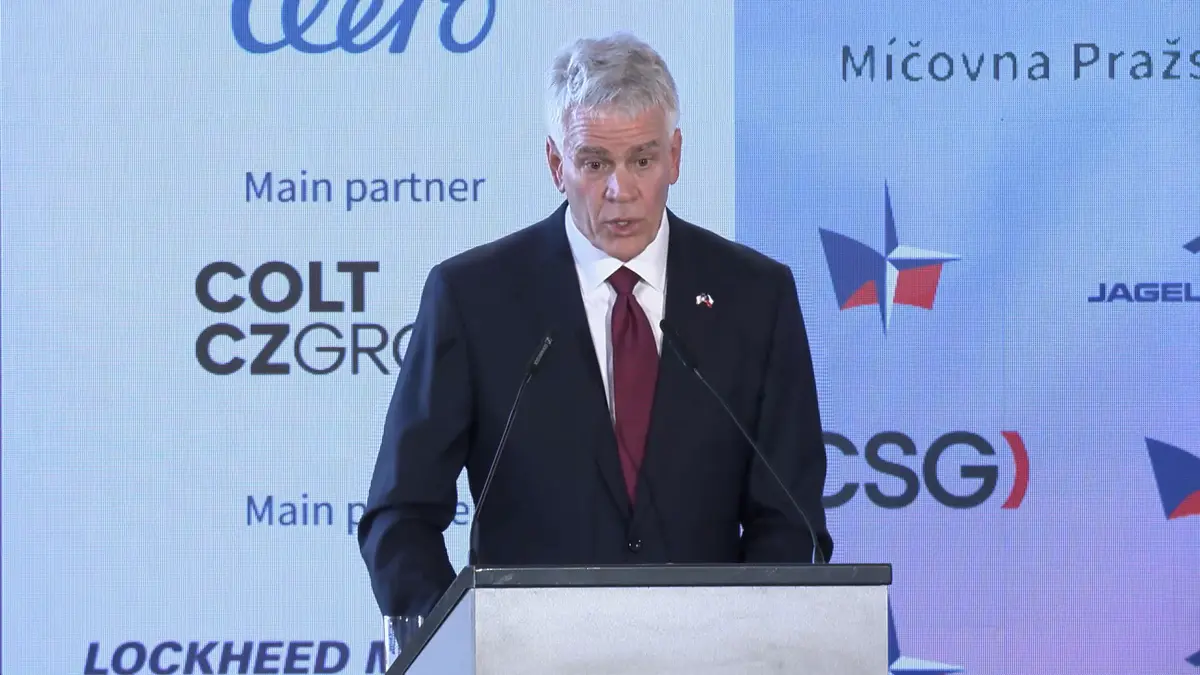
“All allies, including the Czech Republic, have committed to meeting the goals in the area of capability building and the resulting funding levels. It is absolutely important to have a plan to achieve these goals. These numbers, 3.5 percent for basic defense and 1.5 for interdisciplinary investments, a total of five percent to be achieved in the next ten years, are not arbitrary,” said Merrick in a sharp speech at the conference Our security is not self-evident.
According to him, in the draft of this year’s budget, the Czech Republic risks being among the countries with the lowest defense expenditures in NATO.
“This is not a demand from the US, it is not a signature of one government that can be canceled by another government, it is an agreement between sovereign allies, each of which relies on the others,” he added.
Merrick recalled that all NATO member states, including the Czech Republic, committed to these goals at last year’s summit in The Hague.
However, the current Czech government rejects the five percent commitment. In a recent interview with Deník, Prime Minister Babiš answered the question of whether we are on the path towards spending of 3.5 percent: “We are definitely not.”
“According to a recent survey, 80 percent of Czechs agree that NATO membership is necessary for the defense and security of the Czech Republic. Czechs believe in NATO, but this belief must be supported by capabilities and determination,” Merrick also said.
I don’t need to remind you how important it is
“According to defense experts, the basic defense spending included in the draft budget for 2026 will be approximately 1.8 percent of GDP. This is well below not only the commitment from the Hague summit, but also the commitment from the summit in Wales and below last year’s level,” the ambassador calculated.
“With 1.8 percent, the Czech Republic would risk being among the countries with the lowest spending in the alliance. It would show negative dynamics compared to other NATO partners. What is even more important is that at this level of spending, the Czech Republic risks not meeting its own spending in the field of capacity building,” he said in his speech.
“If the Czech Republic does not fulfill its obligations, it will have an impact on the entire alliance, and I don’t even need to remind the Czech people how important it is for the allies to keep their obligations,” he added.
According to Merrick, difficult decisions cannot be postponed until the next budget cycle, and the arguments of a complex political situation will not stand up either. “All NATO members also face future elections, complex coalitions and opposing political parties, election promises and competing claims for limited government resources. All allies face their own political pressures and fiscal constraints, but they are still making tough decisions, both in Europe and across the Atlantic,” the ambassador said.
“If there is a conflict, it is not safe to sit on the sidelines. Security comes from commitment. Commitment leads to capabilities, capabilities make us stronger, and only that power leads to deterrence. Deterrence is real security,” he continued. “But in Prague we are still having talks about the first step on this path, about the commitment,” he added.
Zúna applauded
Merrick said that the United States has excellent relations with the Czech government. He also mentioned that the first vice-president and Minister of Industry Karel Havlíček (ANO) will visit the USA, and Merrick will accompany him.
“At the same time, Mr. Havlíček will hear exactly the same message regarding NATO and our common security, as the Czech representatives heard it from our highest government representatives. Especially since last June’s summit, all member states must have an action plan to meet capacity goals and increase defense spending from two percent to 3.5 in the next ten years, with positive dynamics expected as early as 2026,” Merrick returned to the main point your message.

“The United States is doing its part and we will continue to do so. We ask our allies, including the Czech Republic, to do the same. Our common security demands it, because when it comes down to it, we are all in it together,” he concluded his speech. This was applauded by both President Petr Pavel and Minister of Defense Jaromír Zůna, who was nominated by the SPD.
Meanwhile, SPD Chairman Tomio Okamura said about the increase in defense spending to five percent in mid-February on CNN Prima News: “It was a commitment of the previous Fial government, and secondly, there is really no money for it. The Czech Republic is in record debt after the Fial government.”
According to the government’s proposal, this year defense should manage the amount of 154.79 billion crowns, which corresponds to less than 1.8 percent of GDP. Total defense spending should be approximately 185 billion crowns this year, of which 30 billion comes from other budget chapters. The Czech Republic should thus spend 2.07 percent of GDP on defense according to the macroeconomic prediction from January.