
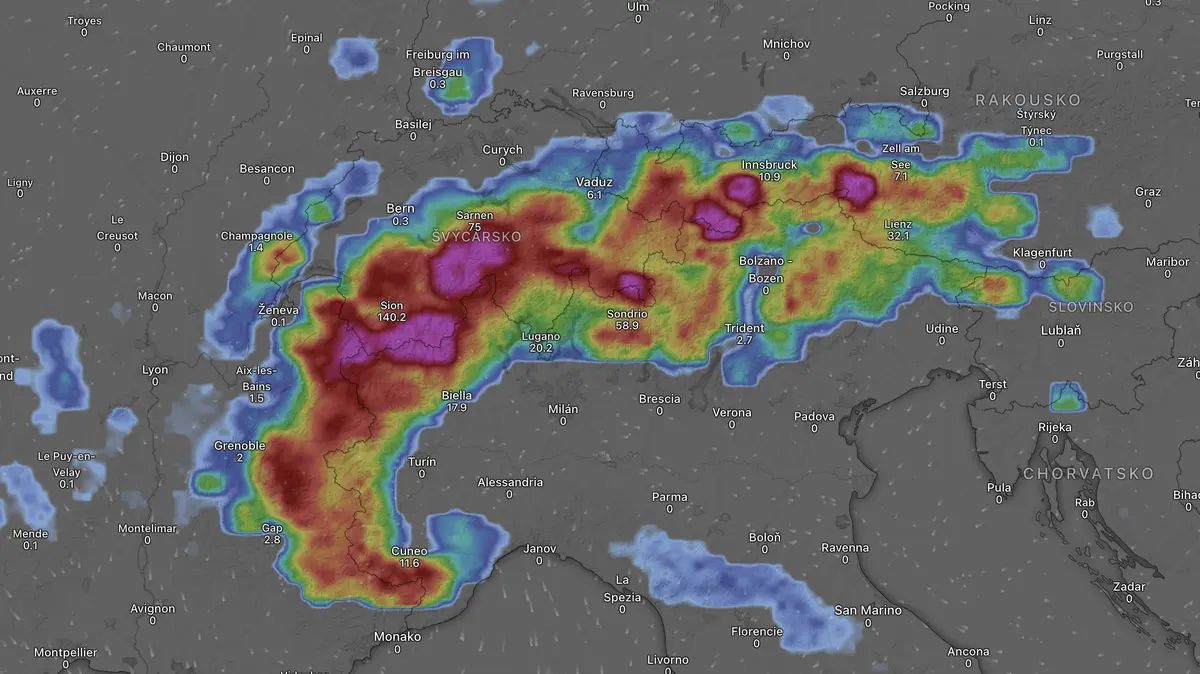
It snowed especially on Saturday during the transition of the cold front from the northwest to the southeast of Europe. It is the same cold front that also brought cooling to the Czech Republic.
On the border of Switzerland and Italy, more than a meter of snow fell at higher altitudes over the weekend. In some places up to two meters of new snow. In some parts, there is over 4 meters of snow.
A record amount fell at the Bosco/Gurin station, where 116 cm fell in 24 hours. According to observers, almost a meter fell overnight in the French valley in the territory of the municipality of Bonneval-sur-Arc.
In Italy, they even reported that a meter and 48 centimeters of snow fell in 24 hours, namely in the village of Macugnaga at an altitude of 1,360 meters above sea level.
❄️ Les Alpes italiennes vivent un épisode neigeux remarquable. À Macugnaga dans le Piémont, il est tombé 1.48 mètre en 24h à 1360m d’altitude! (© Mihaela Ianuș) pic.twitter.com/CTehUlDLNo
— Meteo Express (@MeteoExpress) March 15, 2026
A large amount of new snow fell especially in France, Switzerland and northwestern Italy. In the Austrian Alps, only the lower tens of centimeters snowed, and overall there is a below-average amount of snow this year.
This is also due to the fact that, since February, the situation prevails when frontal systems come to the Alps from the west of the Atlantic, and the most snow falls in the French and Swiss Alps, or in the Italian Alps in the northwest of the country. In December and January, it did not snow much overall, because high pressure prevailed in the area.
However, the west-east gradient can also be seen in Switzerland, where in the western part of the Swiss Alps there is an above-average amount of snow at higher altitudes, but in the eastern part there is a below-average amount. In general, however, it can be seen that there is less snow than usual at lower altitudes, due to the fact that the precipitation here is rather in the form of rain and not snow.
New flurries of snow will certainly please skiers, but a large amount of fresh snow also results in an increased risk of avalanches. In the French and Italian Alps, the fourth avalanche danger level out of five applies.
On Tuesday, on the other hand, more snow could fall in the Austrian Alps and it will not snow in the Western Alps.
