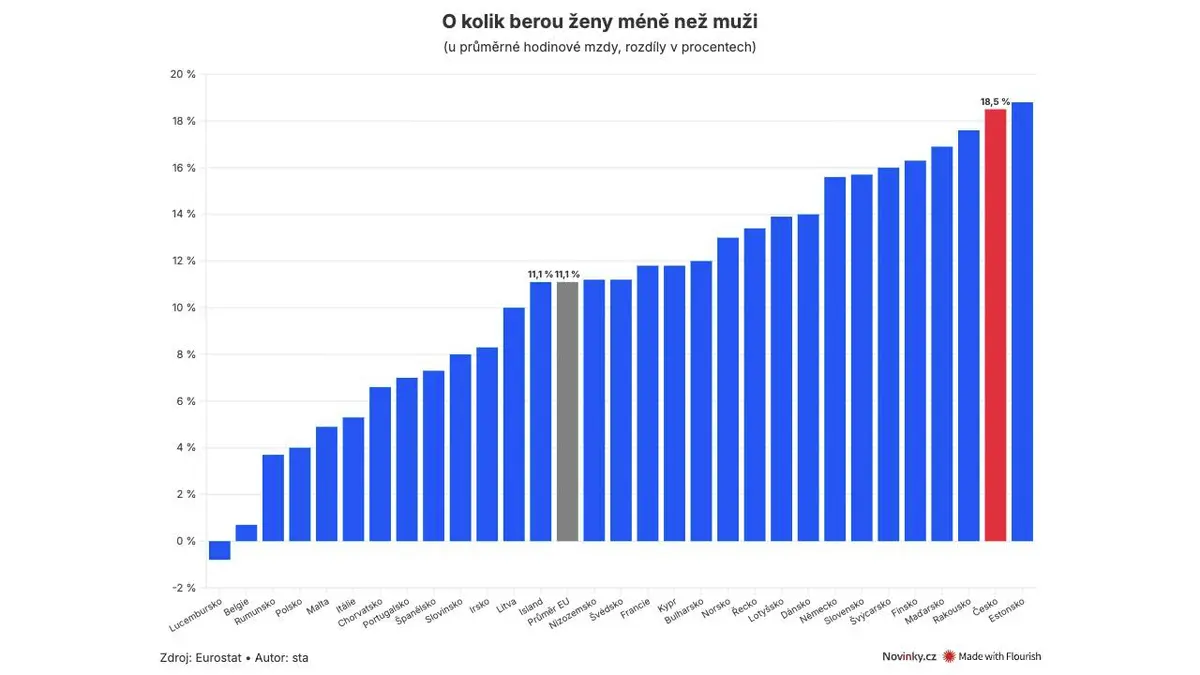
The data is currently published by the European statistical office Eurostat. According to economist Vít from the company Investika, the reason for the poor wage evaluation of women is the relatively conservative setting of Czech society, where some things change only gradually.
“But the main reason will probably still be the relatively strong position of the industry, which offers greater employment to men,” he said.
A role is also played by the fact that, compared to Western countries, relatively few part-time jobs are offered in the country, which would provide women with income during parental leave and the opportunity to continue their career even while taking care of children.
“The gender pay gap is generally much lower for people just entering the labor market, and it usually increases with age,” stated Eurostat.
The lowest wage differences between the sexes are thus in the age group under 25, namely 7.7 percent. They continue to increase and are the highest at the age of 35 to 44 years. According to statistics, women of this age in the Czech Republic take 21.6 percent less than men. This is followed by a gradual decrease in the differences, up to 8.2 percent among workers aged 65 and over.
The opposite trend in Luxembourg
For example, in Slovakia, women earn an average of 15.7 percent less, in Germany by 15.6 percent and in Poland by four percent.
The smallest differences are in Belgium, namely 0.7 percent. “The only country in the European Union where men earned less than women on average is Luxembourg,” the statisticians stated. Men there have almost a percentage of lower wages.
The data come from the year before last year, Eurostat should only publish the newer ones at the turn of the year.
In the Czech Republic, wage differences worsened slightly, reaching eighteen percent in 2023. According to economists, this is only a slight difference, from which not much can be deduced, and it can change in one direction or the other from year to year.
Survey
Why do you think women take less money than men?
They tend to be less capable than men.
They tend to have less knowledge than men.
They are less penetrating than men.
They are more modest than men.
It offends them to ask for a salary increase.
They focus less on work when they take care of their family.
A total of 3250 readers voted.
However, even in 2021, the difference was only 15.4 percent and the Czechs were better off than Slovaks, Austrians, Germans or Finns.
From the point of view of the sector, women working in water and waste management are the best. They take only 1.3 percent less than their male counterparts. At the same time, however, there are fewer of them operating in this area.
The difference is below ten percent in the construction industry, in transport and storage, and in the field of real estate.
The highest, 35.6 percent, is in finance and insurance, followed by IT and communications with 28.4 percent and healthcare and social care with 24.9 percent.
As for the pension paid to people older than 65, the difference is 9.6 percent to the disadvantage of women. They have lower differences only in Slovakia and Estonia, and from countries outside the EU in Montenegro.
“The Czech pension system is relatively egalitarian, and the incomes of seniors are quite comparable to their previous earnings. They only play a limited role in pension calculations,” summarized economist Petr Dufek from Creditas Bank.