
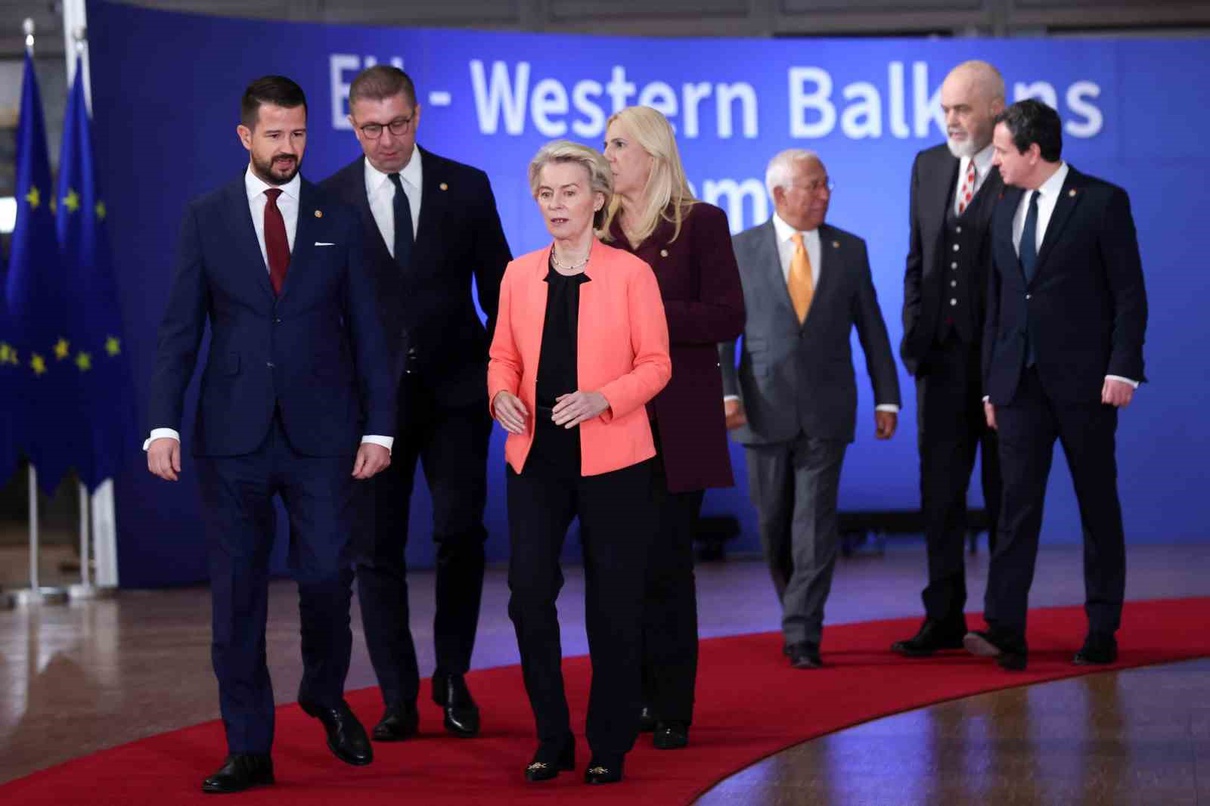
European Union (EU) Commission President Ursula von der Leyen, in her statement after the EU-Western Balkans Summit, said, “Enlargement is a strategic necessity for Europe.”
President of the European Council Antonio Costa and President of the EU Commission Ursula von der Leyen held a joint press conference after the EU-Western Balkans Summit held in Brussels. EU Council President Costa said that due to the difficult geopolitical situation, the need to establish an increasingly closer relationship between the EU and the Western Balkans has become more evident. “Today’s summit reaffirmed the Western Balkans’ European Union membership perspective,” Costa said.
“We have started to prepare Montenegro’s accession agreement”
Pointing out the progress achieved by the regional countries Montenegro and Albania in the EU membership process, Costa said, “This proves that accession to the European Union is not a dream, but a real opportunity for those who strive. This year, we started to prepare Montenegro’s accession treaty. This is a step we have not taken for more than ten years. Albania has also started to close the negotiation chapters. All our other partners in the Western Balkans can also make progress in their own accession processes if they wish.”
On the other hand, Costa also touched upon the issue of “good relations with neighbors”, one of the issues that the candidate countries have the most problems with, and said, “This path to the European Union is not just about implementing the necessary reforms. Regional cooperation, reconciliation and good neighborly relations are the basic prerequisites for participation in the European Union. I expect more progress in the solution of bilateral issues. Problems arising from the past need to be overcome. It is time to look forward, not back.”
In his answer to a question at the press conference indicating Serbia’s non-participation in the summit, Costa said that he met with Aleksandar Cupic, who is the acting President of Serbia, and Cupic explained that they could not attend due to urgent work in the Serbian Parliament.
Pointing out that Serbia’s reason for not attending the summit was different from previous ones, Costa said, “We will have new opportunities for contacts with Serbian authorities to advance the EU accession process.”
Leyen: “Enlargement is a strategic necessity for Europe”
EU Commission President Ursula von der Leyen said in her statement, “Enlargement is a strategic necessity for Europe. Today, we are facing real momentum. When you look at all the negotiations we have carried out, we are on track to open and close more than 100 chapters this year.”
Stating that the world is changing rapidly and Europe needs to be stronger and united to cope with these, Leyen said, “Montenegro is approaching the finish line in the accession negotiations. Albania continues to move towards this line at an impressive pace.”
Stating that the Union is also preparing for expansion, Leyen said, “We evaluated what the expansion means for our institutions, policies and budget. Because the expansion must be successful for both current and future member states.”
Stating that steps will be taken towards gradual integration with the Western Balkan countries, Von der Leyen said, “At the beginning of next year, we will initiate gradual integration dialogues specific to each partner. We want to identify new opportunities for them in our single market.”
Mickoski: “Our citizens were disappointed because they were kept waiting in the backyard”
The leaders of North Macedonia and Montenegro drew attention to the effects of bilateral disputes on the process. Speaking to the press before the summit, North Macedonian Prime Minister Hristijan Mickoski argued that the EU membership process should proceed based on merit, not bilateral disagreements. Mickoski argued that amending the constitution of North Macedonia, which is faced with the demands of its EU neighbor Bulgaria regarding the Bulgarian minority during the membership process, will not be enough to remove the obstacles in front of them.
Demanding that the EU change its approach towards the Western Balkans, Mickoski said, “We belong to Europe. Our citizens are very disappointed because they have been kept waiting in the backyard for too long. Finally, we want to deserve our place at the table with a merit-based approach.”
Milatovic: “At the time Croatia entered the EU, the border issue with Slovenia was not resolved”
Montenegrin President Jakov Milatovic drew attention to the difficulties his country is experiencing due to the demands of its EU neighbor Croatia. Suggesting international jurisdiction or arbitration for issues that cannot be resolved with Croatia, Milatovic said, “We do not want anything more from Croatia than it had in its relations with Slovenia when they entered the EU. If we fail, there is always the option of international court or international arbitration.”
Stating that they were under pressure regarding the border dispute with Croatia, the Montenegrin leader said, “The border issue with Slovenia was not resolved when Croatia entered the EU. Despite this, it entered the EU. Now why are they insisting on signing some things? This seems a bit like blackmail.”
Milatovic said his country hopes to complete all chapters by the end of the year and sign the accession agreement by the summer of next year. Milatovic said, “Montenegro can become the 28th member of the EU in 2028.”
Before the summit, Albanian Prime Minister Edi Rama called on the EU to take a bold step and bring all candidate countries to the same table with the EU, while the membership processes continue to be preserved.
President of the Presidency Council of Bosnia and Herzegovina, Zeljka Cvijanovic, said that Bosnia and Herzegovina’s European integration process was blocked due to political disagreements within the country, but that her country was not the only responsible for the disruptions in relations with the EU.
“We don’t want privilege or favour”
Kosovo Prime Minister Albin Kurti stated that nearly four years have passed since his country’s membership application and requested that Kosovo be given candidate status to the EU. Emphasizing that candidate status is an urgent issue for them, Kurti said, “We do not want an award, privilege or favor. We just want the progress achieved by Kosovo to be accepted and recognized.”
Kurti called on the new administration in Serbia to deliver Milan Radoicic, who led the Banjska attack in 2023.
