
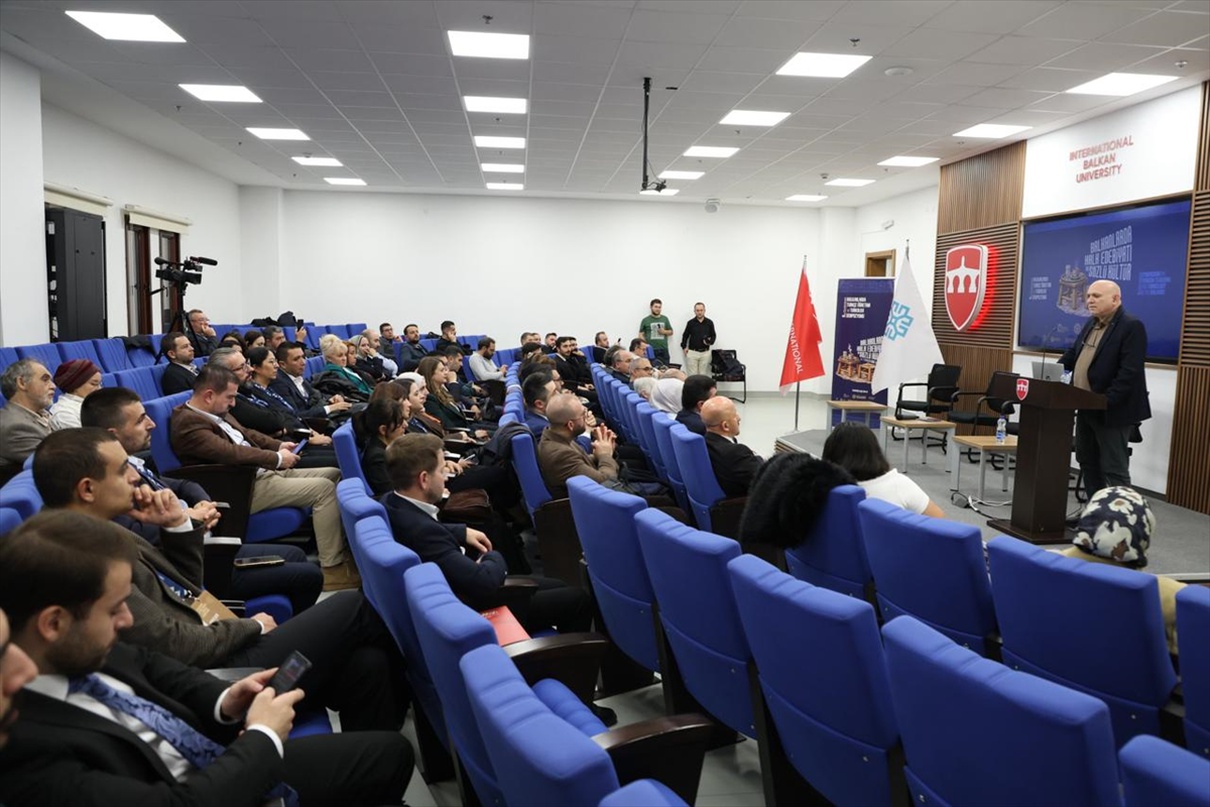
“5th International Symposium on Teaching Turkish in the Balkans and Turcology”, which aims to contribute to the evaluation of academic studies on teaching Turkish in the Balkans and the field of Turcology, researching the language and cultural heritage of the region, and developing new collaborations between scientists from different countries, has ended.
The symposium was organized in cooperation with the Turkish Maarif Foundation and New York University Balkan Studies Center in Tirana.
At the symposium held at the International Balkan University, Prof. Dr. Metin İzeti, Raif Vırmiça and Assoc. Dr. The panel titled “Oral Culture in the Balkans” was attended by İsa Sülçevsi and Prof. Dr. Mustafa İsen directed it. The effects of Yunus Emre, Mevlana and Niyazi-i Mısri in Balkan literature and the Melami and Mevlit tradition in Kosovo were discussed in the panel.
Within the scope of the symposium, Necmettin Erbakan University Turkish Music State Conservatory Executive Committee, Prof. Dr. He performed a musical concert titled “Balkan Folk Songs from Language to Language” under the general artistic direction of Mehmet Gönül.
“Çanakkale is the common memory of Turkish and Muslim people”
Prof. Dr. Ertuğrul Karakuş, in his paper titled “Oral History-Memorabilia Compilations on the Trail of the Lost Soul: From Macedonia to Çanakkale”, explained that the Macedonia region showed its commitment to Turkish-Islamic culture and civilization at every opportunity from the 14th century, when it was under the rule of the Ottoman Empire, until the end of the 19th century.
Karakuş said, “The reciprocity of this ‘adoption’ situation is the guarantee of the ties that have survived to the present day. However, with the extraordinarily rapid and strong impact of technology and Western cultural imperialism on the youth, the danger of quantitatively and qualitatively weakening of these ties, compared to previous generations, has begun to appear as an extremely important danger both in the Macedonia region and in the entire Balkan region. A large part of the common memory of Turkey and the Turkish or Muslim people living in that region is held by the memories of Çanakkale.” he said.
Prof. Dr. Mehmet Celal Varışoğlu, in his presentation titled “Cultural Keywords in the Context of Migration in Leyla Şerif Emin’s Poems”, stated that migration from the Balkans to Anatolia continued in waves for more than 100 years, from the 1877-1878 Ottoman-Russian War to the 1989 Bulgarian forced migration and the years following the dissolution of Yugoslavia, and that this affected the lives of those who stayed in the Balkans as well as those who left. He said it deeply affected him.
Referring to the reflection of migration experiences, Varışoğlu said:
“It is necessary to determine the words around which the migration experience is built and to interpret the cultural meaning and social tensions carried by these words in A Skopje Tale, the only published poetry book of the Turkish poet Leyla Şerif Emin, a citizen of the Republic of North Macedonia. The poet, who was one of those who did not emigrate, witnessed the migration that took place during and after the dissolution of Yugoslavia, and the previous waves entered his poems as a transferred memory.”
Comparison of “The Gardener and Death” and “My Futile Life”
Lecturer, who deals with the subject of gardening in the novel “The Gardener and Death” by Georgi Gospodinov from Bulgarian literature and in the long story “My Useless Life” by Mustafa Kutlu from Turkish literature. See. Dr. Esma Nur Çetinkaya Karadağ also made the following evaluation:
“In both works, the garden ceases to be just a place where plants are grown, and turns into a fundamental area that gives meaning to the characters’ lives, where they establish belonging and express themselves. While the main character Yadigar in Beyhude Ömrüm makes turning a stony and barren land into a garden one of the most important goals of her life, in The Gardener and Death, the garden is the basic place where the narrator’s father expresses himself, clings to life and establishes a relationship with the outside world.”
Res. See. Dr. In his presentation titled “Istanbul in Bosnian Jokes: Cultural Memory and City Image”, Ali Mehmet Gürsel pointed out that compared to other cities, Istanbul has a special importance for Bosnians and gave the following information:
“Today, Bosnians continue to see Istanbul as the most important city of the Islamic world after Mecca and Medina. Istanbul is neither the capital nor the center of the caliphate, but the longing and respect that Bosnians feel for this city continues without losing its value. The subject of some Bosnian jokes is Istanbul or the events take place directly in Istanbul.”
The historical development and cultural continuity of Turkish folk poetry can be observed in the Balkans.
Dr. Lecturer Member Gülçin Balat, in her presentation titled “Turkish Folk Poetry Tradition and Its Representatives in the Balkans”, emphasized that the Balkans are one of the important areas where the historical development and cultural continuity of Turkish folk poetry can be observed and said, “Conquest and settlement movements during the Ottoman period, dervishes, army poets and wandering minstrels who came to the region from Anatolia were effective in carrying the tradition to the Balkans. Poets born and raised in the region acquired this knowledge through local experiences.” continued to enrich it.” made the statement.
Eyyup Bostancı examined the famous Turkish Letters of Ogier Ghiselin de Busbecq, who came to the Ottoman geography as the ambassador of the Holy Roman-Germanic Empire in the 16th century, in the context of Balkan oral culture and folklore. Bostancı stated that during his many years of travels, Busbecq also made scientific and cultural discoveries such as bringing the inscriptions in the Temple of Augustus into Western literature and transporting angora goats and tulip bulbs to Europe.
“There is a dynamic cultural memory area in My Name is Aymaz TV series”
Dr. Lecturer Member Emine Ulu focused on the elements through which Balkan oral culture and cultural memory are represented in the 10-episode series “My Name is Aylamaz” published on the digital platform. Ulu stated that in the series, Balkan oral culture is not presented as a folkloric setting, but is structured as a dynamic cultural memory area that establishes a relationship between past and present, individual and community, and tradition and modernity.
Dr. Firdevs Kapusızoğlu, in his presentation titled “From Saltukname to Fantastic Children’s Literature: Narrative Possibilities and Adaptation Problems”, pointed out that Sarı Saltuk is a veteran-dervish figure whose historical personality and hagiographic identity are intertwined, who emerged during the settlement movements from Anatolia to the Balkans in the 13th century, and said, “Saltukname brings together people, places and motifs belonging to Anatolian and Balkan narrative traditions.” “It is considered as a work that reflects the cultural circulation between the two regions.” he said.
“Saltukname can create a new generation of readers when transferred to fantasy children’s literature.”
Kapusızoğlu stated that Saltukname, when transferred to fantasy children’s literature, has the opportunity to re-function this cultural memory, which has circulated between Anatolia and the Balkans for centuries, for a new generation of readers.
Evaluating Yahya Kemal’s memories of Skopje, Prof. Dr. Mehmet Samsakçı also emphasized the formation of cultural belonging and made the following evaluation:
“Yahya Kemal’s memories of his childhood and the narratives he wrote about Skopje allow us to see together the architectural spaces, belief world, clothing, forms of entertainment and oral culture of a Rumelian city at the end of the 19th century. These texts, in which the poet’s personal history and the social life of the city are intertwined, provide remarkable materials in terms of understanding the details of daily life and the formation of cultural belonging.”
Assoc. Dr. In his speech titled “International Students’ Perceptions of Turkish Language and Culture”, Tarık Demir stated that Türkiye has become a global education center with the internationalization policies and cultural diplomacy activities it has carried out in recent years, and that international students coming to Türkiye from the Balkan geography, where historical, geographical and socio-cultural ties are deep-rooted, have a strategic position in this process.
The full texts of the papers presented at the symposium organized with the theme of “Folk Literature and Oral Culture in the Balkans” with the support of the Turkish Language Association, Yunus Emre Institute, Presidency for Turks Abroad and Related Communities, Turkish Cooperation and Coordination Agency and Halkbank will be brought together in the proceedings book to be published by Turkish Maarif Foundation Publications UNYT Press.
