
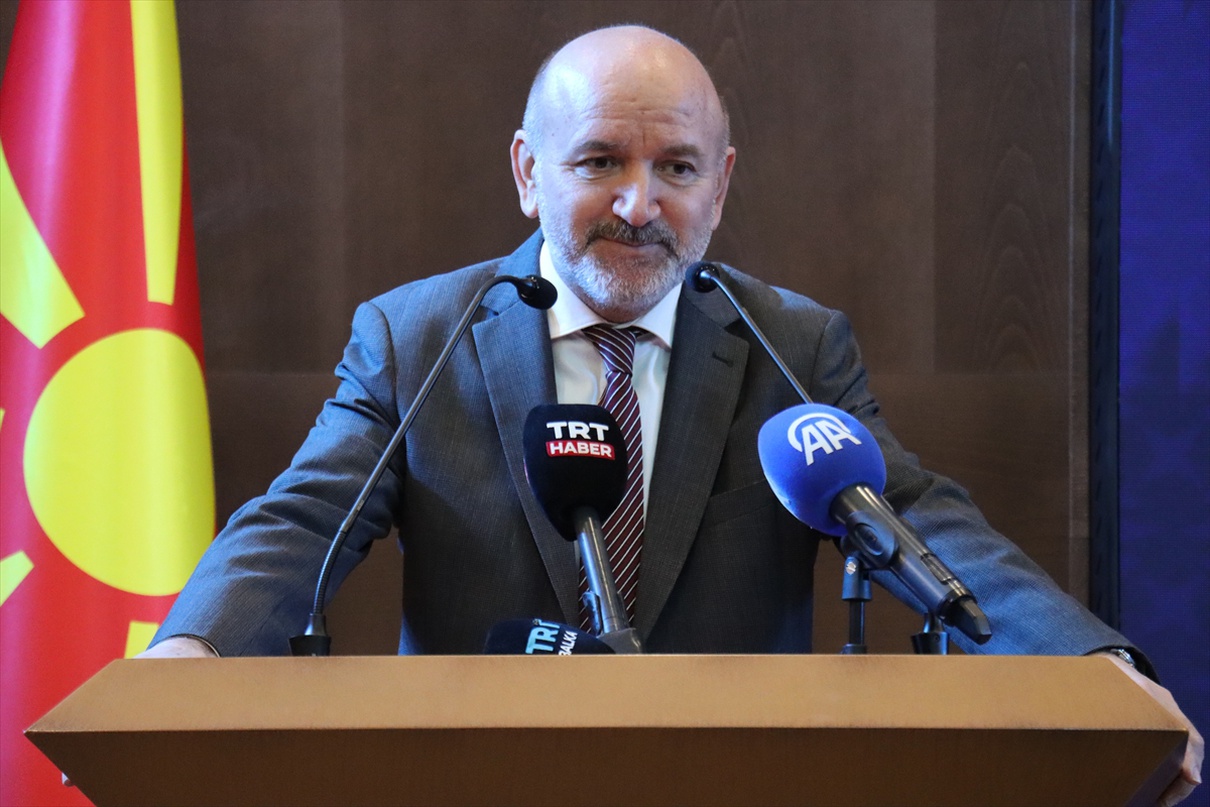
“5th International Symposium on Teaching Turkish and Turcology in the Balkans” started in Skopje, the capital of North Macedonia.
The symposium, hosted by the International Balkan University (IBU) in cooperation with the Turkish Maarif Foundation (TMV) and the New York University of Tirana (UNYT) affiliated with the foundation, was attended by Deputy Minister of Foreign Affairs Hacı Ali Özel, Türkiye’s Ambassador to Skopje Alper Aktaş, North Macedonian Minister of State for International Cooperation and Foreign Investments Zülfikar Zeynula, North Macedonia Deputy Minister of Education and Science Driton Sulejmani, representatives of Turkish institutions and organizations in the country and academicians. and students participated.
In his speech here, Özel said that he believed that the symposium would make significant contributions to strengthening the presence of Turkish in the Balkans and developing academic cooperation in the field of Turcology.
Noting that Turkish has served as a bridge in the Balkans for centuries, Özel said, “In this geography, Turkish has found a place in poems, folk songs, fairy tales, proverbs, architecture, the memory of cities and daily life. It has created a common ground of communication and interaction in the Balkans, where different languages, beliefs and cultures live together. It is our common obligation to preserve, research and transfer this memory to young generations.” he said.
Özel emphasized that they see teaching Turkish abroad and promoting Turkish culture as one of the most important foreign policy dimensions of Türkiye.
Zeynula also stated that Turkish is an important language spoken in the Balkans not only today but also since the past.
Touching on the importance of keeping Turkish alive, Zeynula said, “Because we know that a nation that loses its language has also lost its existence.” he said.
“Turkish is an important language for this geography”
Sulejmani stated that the identity of the Balkans has been shaped by the interaction of different peoples, languages, religions, traditions and civilizations over the centuries.
Underlining that the diversity of the region is not just a geographical feature, Sulejmani said, “This is one of our greatest cultural and intellectual assets. North Macedonia is a particularly meaningful place to address this diversity. Our country is home to communities with different linguistic, ethnic and cultural backgrounds that have contributed to the richness of our common society with their traditions and history. Turkish language and culture have an important place in our common heritage.” made his assessment.
President of the Turkish Maarif Foundation, Mahmut Mustafa Özdil, also touched upon the importance of the symposium, which was held for the 5th time this year, and said, “This conference is valuable for us as a platform where we can not only inform the world about our own work, but also lay the groundwork for joint studies. We hope that we can get closer to this goal by intensifying and increasing the participation, especially from the Balkan countries, in the coming years.” he said.
IBU Rector Prof. Dr. Mehmet Bulut pointed out that Turkish has a deep-rooted history in the Balkans and said, “Turkish is an important language for this geography.” he said.
After the opening speeches, the symposium was opened by Prof. Dr. It continued with conferences and panels given by Sadettin Ökten.
The symposium, organized this year with the theme of “Folk Literature and Oral Culture in the Balkans” with the support of the Turkish Language Association, Yunus Emre Institute, Presidency for Turks Abroad and Related Communities, Turkish Cooperation and Coordination Agency and Halkbank, will end on November 7 after different panels and a cultural tour.
