
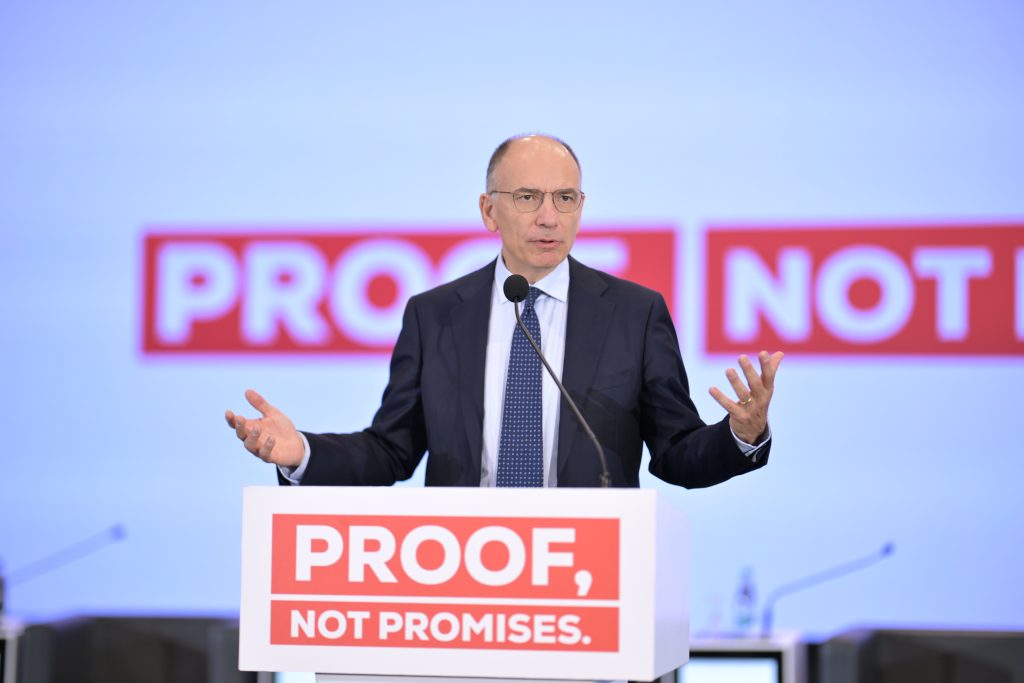
At the Forum of Civil Society and Think Tanks 2026, held in Pristina, former Italian Prime Minister and author of the report “One Europe, One Market”, Enrico Letta, called for a new approach of the European Union to enlargement, placing emphasis on the concrete implementation of reforms and the gradual integration of candidate countries into the European common market.
In his speech, Letta stated that Europe is at a decisive moment, where citizens are looking for tangible results and not just political promises.
Enrico Letta said that “When I saw the title of this event, ‘Evidence, not promises’, I immediately understood that this is the title that should be placed on the door of every European institution. If we fail to link implementation to what we do at European level, we will lose the European dream. Today, the question being asked across Europe is the same: is Europe able to implement?”
According to him, the biggest challenge facing the European Union is not the lack of plans or strategies, but the ability to turn them into concrete results for the citizens.
Speaking about the EU’s economic competitiveness, Letta warned that the fragmentation of the European market is weakening the continent’s position in the face of major global economic powers.
“Europe represents one of the largest economies in the world, but it continues to be fragmented. In finance, technology and investment we are paying the cost of this fragmentation. In the world of China, India, BRICS and American finance, we are all small countries, including those who have not yet realized this. The only way to economic, financial and technological security is integration,” he said.
An important part of the speech was devoted to the plan approved by the European Council in April 2026, “One Europe, One Market”, which contains 42 measures for deepening the economic, financial and energy integration of the European Union.
Letta emphasized that the Union of Savings and Investments, the creation of a common regulatory framework for businesses and the construction of an integrated energy network are among the reforms that will determine the future of the EU.
He also introduced the concept of the “fifth freedom”, aimed at the free movement of knowledge, scientific research and professional skills across the continent.
“The four fundamental freedoms of the common market were built for the industrial economy. The modern economy is based on knowledge. Europe has great research potential, but it remains fragmented and is losing talent to the United States. The fifth freedom is the answer to this challenge,” stated Letta.
Focusing on the European Union expansion process, he argued that the integration of the Western Balkan countries should not remain a technical process limited to negotiations and chapters, but should bring concrete benefits to citizens even before formal membership.
“If enlargement is perceived only as a dialogue between governments and Brussels, then the meaning of Europe is lost. The common market must become part of the daily life of citizens in candidate countries before membership. This is how the cycle of promises without evidence is broken,” he said.
Letta also admitted that the previous enlargement of the European Union had an important shortcoming: the lack of sufficient cooperation between the candidate countries themselves.
“The mistake we made was that we built every relationship between a candidate country and Brussels. We didn’t encourage the candidate countries enough to build working relationships and markets with each other. If we want to be with Brussels, but we don’t like the neighboring country, then that’s the opposite of how Europe works,” he said.
At the end of the speech, Letta called for a greater commitment of civil society, universities and research institutes in pushing forward the European reforms, emphasizing that the European project remains one of the most successful stories of the transformation of borders from areas of conflict to areas of cooperation.
“Europe has shown that borders can be transformed from places of division into spaces of cooperation. This is its greatest achievement. Proof, not promises. I will take this message with me to Brussels and I hope you will too,” concluded Enrico Letta.
